Apple Podcasts
 Spotify
 RSS Feed
 From Pro Triathlete to Deck Referee: Why Officiating Swimming Is So Rewarding: Chet Goudy, EP 315
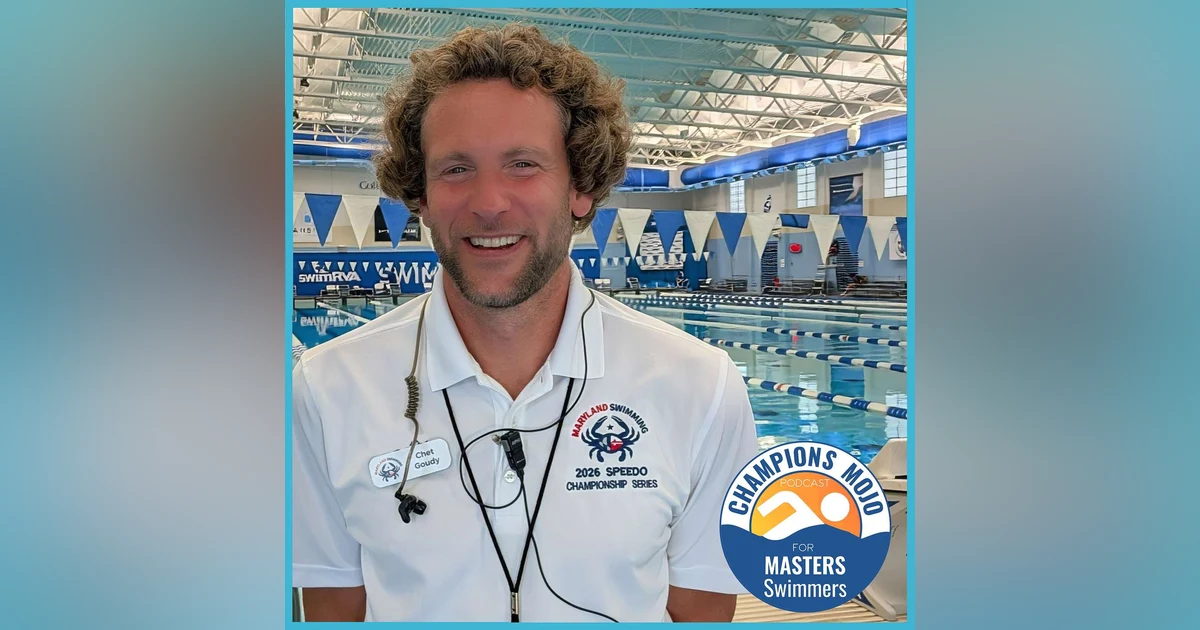
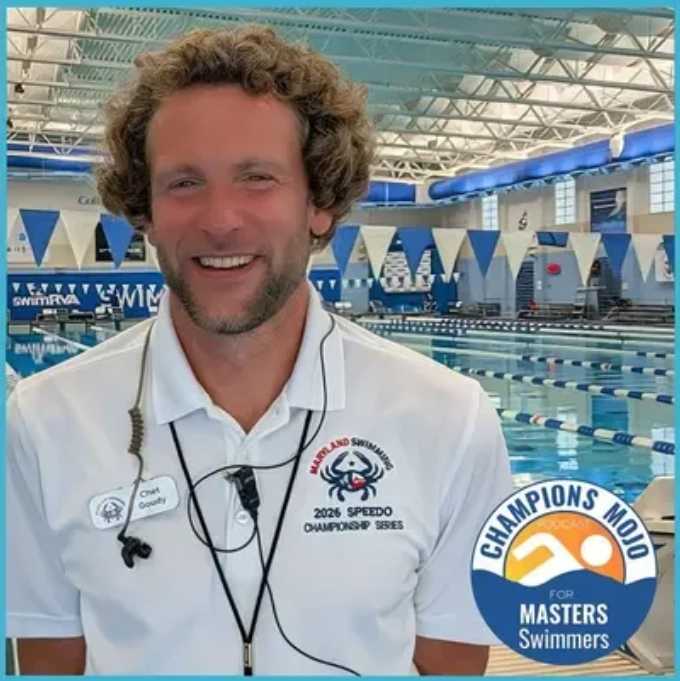
You can love swimming and still feel intimidated by the rulebook, the whistles, and the idea of disqualifying someone. That hesitation is exactly why we wanted an on-deck conversation with Chet Goudy, a USA Swimming deck referee, Masters swimmer, former college breaststroker, and former pro triathlete. He walks us through what a deck ref actually does, what it feels like to run a session from the pool deck, and why meets are always desperate for more well-trained officials.
We also get personal about how people find their way back to the water. Chet shares the detour he took away from swimming in high school, the grind of returning for college, and the kind of “legendary” training that rewards durable athletes. From there we jump into Masters swimming culture with the Annapolis Breakfast Club, where 4,000-yard mornings are normal and “Fitness February” means 5,000 a day to build toward open water challenges like the Chesapeake Bay Swim.
Then we zoom out to endurance sport and mindset. Chet explains how a coach transformed his triathlon training by making every session purposeful, controlled, and measurable, leading to a pro card and later a 13-week comeback plan to win a race after years away. If you’re a swim parent, a Masters swimmer, or someone curious about volunteering at swim meets, you’ll leave with clear next steps and a fresh view of what it means to support the sport.
• deck referee responsibilities and how officiating is the best seat
• becoming an official through apprenticeship and on-deck mentoring
• why disqualifications help swimmers learn rather than punish them
• the social side of officiating and why more officials make meets better
• Masters at the Annapolis Breakfast Club with 4,000 yard workouts
• preparing for open water goals like the Chesapeake Bay Swim
• “train on purpose” lessons from triathlon coaching and earning a pro card
Subscribe for more conversations that help you live well and swim well, share this with a swim friend, and leave us a review if it helped you see the pool deck in a new way.
Email us at HELLO@ChampionsMojo.com. Opinions discussed are not medical advice, please seek a medical professional for your own health concerns.
You can learn more about the Host and Founder of Champions Mojo at www.KellyPalace.com
00:00 - A 13-Week Plan To Win
00:15 - Meet Day And The Deck Ref Role
02:29 - Quitting Swimming Then Returning Strong
06:16 - Masters Training And The 5,000 Challenge
08:09 - How To Start Officiating Without Fear
11:45 - Earning A Pro Card And A Comeback Win
14:54 - Pool Business And Final Thanks
A 13-Week Plan To Win
SPEAKER_01
All right, here's what we're gonna do. There's a race in early spring. I'm gonna pull my book out. It's 13 weeks. I know exactly what I have to do. Kids, I'm gonna follow this plan step by step and do everything exactly right, and I'm gonna go win that race.
Meet Day And The Deck Ref Role
SPEAKER_00
Hello, friends. Welcome to the Champions Mojo podcast, where we bring you interviews and topics to help you live well and swim well, conversations especially meaningful for master swimmers and anyone striving to perform better in the water or in life. We're here to champion you. And now your host, Kelly Pallas.
SPEAKER_02
I am so excited to be doing an on-deck interview with Chet Gowdy. He was a college swimmer, a pro triathlete. He's now a master swimmer, and he is officiating at a big USA meet. And Chet, thank you so much. Welcome to Champions Mojo. First, let's start with your officiating. You're a USA swimming official. And what position are you working today?
SPEAKER_01
Um I worked as a deck ref for this entire meet.
SPEAKER_02
What does a deck ref do?
SPEAKER_01
The deck ref um is in charge of the pool. Everything that happens, and everybody that's working. Um the meat ref is in charge of the meat, but the deck ref is handling what's going on in the water.
SPEAKER_02
So you obviously love swimming. How did you get into being an official and what's the rewarding part of it?
SPEAKER_01
Uh well, my kids decided to swim uh year round, and I grew up coaching, so I was either gonna coach or do something. I wasn't gonna sit in the stands. So my wife begged me not to coach again because I stopped when my first was born. Um and so I said, well, fine, I'll officiate. So and we they always need more officials as it is.
SPEAKER_02
So how long have you been doing this?
SPEAKER_01
Uh since Noelle started, so this is year four or five. Um, you asked what the rewarding part is. Um it's nice to be on deck when parents can't get on deck with the kids. So, you know, my kids are around me all the time and they come up and talk, and other parents like to say that their kids refuse to acknowledge them, whereas mine still come up. So I'm glad.
SPEAKER_02
That's
Quitting Swimming Then Returning Strong
SPEAKER_02
cool. Okay, so let's get into your um a little bit of your swimming history, like where you grew up swimming, you maybe your USA, and then how you got into college swimming, and then transitioned to I'm t I'm guessing traplons and then masters, but it may be the other way around.
SPEAKER_01
So yeah, so I grew up swimming at SPY in Saverna Park, Maryland. Um I played lacrosse, I was in band, and I swam. When I got to ninth grade, I decided I wanted to be the drum major of the marching band. And at the so at the time I stopped playing lacrosse and stopped swimming. Um to be the drum major, you gotta be the best. So you're you know, you're hand picked, and it was kind of like my ultimate goal at that moment. Um, and so I wound up being the drum major and everything was great. However, I missed swimming. And I didn't really intend on going to college. I thought I'd just work with my dad. And my dad said, No, you're gonna go. And I said, Well, if I go, I'm gonna swim. So, senior year of high school, I called my head coach and he said, Sure, come on back. So I started out with three years of being dry, and I was terrible. Um, and it took it took many months to get back into some kind of shape. Um, so I continued with SPY my first year of college, going to the community college, and then transferred to Towson. Um and then swam the final three years there, and that was the greatest thing ever. Um, and it was probably the hardest thing other than having kids.
SPEAKER_02
Oh swimming in college.
SPEAKER_01
Yes.
SPEAKER_02
So I've heard a legendary set that you did. You want to share that with us? What Mark told me about it. So tell us about this legendary set.
SPEAKER_01
Uh well, in college we used to do 2200s uh stroke.
SPEAKER_02
What stroke?
SPEAKER_01
Breaststroke.
SPEAKER_02
You were so you were a breaststroker?
SPEAKER_01
Yes. Uh I'm sure I had other kids do backstroke and fly, but you know, the breaststrokers did breast. Um and it I loved it. It took it took like six or seven or eight to get into it. And then by 11, 12, 13, you could really roll. However, I was rolling over the kids who were in the relays because I couldn't do a 50 or 100 to save my life faster than they could. But if we did many 200s, then that's where I got to take over.
SPEAKER_02
So you're a distance swimmer. Did that lead you into triathlons like swimming the mile? What was the next trajectory of your swimming career?
SPEAKER_01
Well, we didn't figure out that I should do distance until my senior year at in college, and then I was on the 800-free relay, and that, you know, that was fun. Um, I couldn't wait for swimming to be over. We counted down the days, and then two weeks after conference championships, I was like, Well, what the heck do I do now? Um, and I didn't swim for I think four or five years after that, and then eventually I got back in the pool and then swimming here and there, and then I had friends doing triathlons, and I knew they were doing well, but I thought I can I can do that. So eventually I was doing triathlons, just a few a year, and these old friends would always beat me. And I told my wife, I know I can be better than this, I need to get a coach and get on a team. Um, and so I did that, and it changed everything about training for me, and kind of really opened my eyes to what I should have been doing. Um, and then, you know, we went from there.
Masters Training And The 5,000 Challenge
SPEAKER_02
So you're obviously a hard-working swimming official. You you're a dad, you're traveling down here to this big meet. Are you swimming yourself and how do you stay in shape yourself?
SPEAKER_01
So, yes. I swim at Riva in Annapolis with ABC, the Annapolis Breakfast Club. Um, I was going five days a week, and then I thought maybe it's too much. I'm thinking back to my triathlon where I would never do anything five days in a row. Um, so now I tried to pickleball on the off days um early in the morning when nobody's awake anyway. So the courts are clear at the gym.
SPEAKER_02
So uh that's great. Tell me more about the Annapolis Breakfast Club, even though we're at a USA meet. I ran into one of your ABC uh master swimmers in the lobby, and she very casually said, you know, because it's unusual to see a, you know, a an older person swimming in a USA meet, but she said, Hey, great job. I'm a master swimmer too. And I said, Oh, well, where do you swim? She said, Oh, it's just the ABC. We're the Annapolis Breakfast Club. And I said, Great. She said, Yeah, we only do 5,000. Or she said, I can only do 5,000. And I said, Wait, I don't even do 5,000. So tell us a little bit about this ABC. It sounds cool. And are you really doing 5,000?
SPEAKER_01
So we generally do 4,000 every day. Um, some of us stay after if we have time, and we'll do extra sets. Um, but in February, it's fitness February, and so we do 5,000 every day. Um, and that the whole point of that is to ramp up because the majority of the thought process is to get ready for the bay swim, which is today, the 14th, um, which I was supposed to be swimming in, um, until my daughter said, we're going to this meet, Dad.
SPEAKER_02
Okay. So that was the the 4.4 Chesapeake Bay, Annapolis, beautiful swim. I've always wanted to do that, never had.
How To Start Officiating Without Fear
SPEAKER_02
So the main thing I would love for you to share with our listeners is just getting more parents or more swimmers into officiating, into USA swimming officiating and also US master swimming officiating. It's such a great way to see swimming from the deck. What would you give advice if somebody's just listening to this and they're like, they love swimming, they have no idea how to get started. Um, what could be some of the step steps and where might they end up on the Olympic pool deck? Do you have aspirations for that in LA in 2028? Are we going to see you there as the deck referee? But give us a little um, give us a some encouragement for people out there and how we can get more officials because they're always needed, right?
SPEAKER_01
Yes. Uh we're always desperate for officials. Um, most people are afraid to officiate because they either think they don't know anything about swimming because they never swam, or B, they don't want to disqualify a kid. Well, love it. By disqualifying the the kid, you're not disqualifying them. They disqualified themselves. And you're bringing it to the attention of the kid and probably the parents and the coaches. So it's a benefit to everybody all the way around. Um, and I even found once I became an official that there were things that I didn't really realize were a thing as a swimmer. But then once I was an official, I was like, oh my gosh, I never thought of that or never would have considered that. Um, keep in mind many of the things that we call are not a benefit to the kid. You know, they're not getting uh an edge up on anybody uh by doing what they're doing. You don't have to know about swimming. Um you apprentice when you first get on deck. And so by that, I mean you stand with somebody and they tell you everything that they're looking at. And um, so that that was kind of nice. The first time I apprenticed, I remember the guy said, Gosh, I think you know more than I do already. Um, which was kind of funny. But um it's also a good group of people. So you run into the same people that you worked with, but you haven't seen them in six months, but you're all still friends. So, and remember you get to be on deck. So that's the best part.
SPEAKER_02
And you get great hospitality, right?
SPEAKER_01
Some places it's really great. Um, we get crab cakes. I've had that before. Um so yeah.
SPEAKER_02
But at least drinks and snacks.
SPEAKER_01
Oh, yes. There's always there's always plenty of food.
unknown
Okay.
SPEAKER_02
And what might be the worst part? Like if you if you somebody's just like, oh, what maybe the worst part isn't that bad.
SPEAKER_01
For me, it's standing still. I will move bricks all day long and never stop and be fine. But if you tell me to stand perfectly still for four hours, that is the hardest part to me.
SPEAKER_02
Okay, and you really have to stand still.
SPEAKER_01
Uh generally, depending on the position you're doing. If you're doing stroke and turn, you may stand on the bulkhead for a four-hour session and you'll step one step up and one step back.
SPEAKER_02
Okay, yeah, that would be a bummer. But there are some sitting positions as well, right?
SPEAKER_01
There are sitting positions, and I try to stress that the more officials we have, it makes it better for every person on deck working. Um, you know, if you have eight and you need eight, well, then nobody gets a break. If you have nine, now you have relief. Well, guess what? If 12 showed up, it would be amazing, and everybody's job would be infinitely easier.
SPEAKER_02
Yeah.
Earning A Pro Card And A Comeback Win
SPEAKER_02
This is awesome. What was the professional triathlon career?
SPEAKER_01
Um Yeah. Yeah. So, well, it was very short. So I joined a team, a triathlon team, PHP I. Um, and I still have some of my best friends of my whole life from that team, um, even though it's not uh, you know, it's no longer around. Um, but my coach ran the team. Um my goal from the beginning was to get my pro card for sprint and Olympic distance. Um, I didn't really like going long and not as hard. I'd rather go real hard for an hour or two. Um, my coach always said, You're really fast, but you're really fragile. So he had to be careful with me uh with overdoing it. Um, but my whole intention was to get the pro card. We went to St. Pete Beach in Florida. Um, that's a really great qualifying race there. I got third. I had to be top three amateur, top three out of the to finish of the amateurs. Um so that was really fun because there was a pro field there and we're all together. Um we're passing each other on the bikes, on the run. So that was really fun. Um, but I I got my top three qualifying finish, and I literally felt like a weight was lifted, and I was like, well, I did it, and now I don't know what to do.
SPEAKER_02
And so that was the end of it.
SPEAKER_01
That I have raced a few more times since then, and I still have all of my stuff. Um, I will never get rid of it. My kids actually asked me a couple years ago, after I had not raced for a few years, you know, what was triathlon? And I was shocked and sad. So I said, all right, here's what we're gonna do. There's a race in early spring. I'm gonna pull my book out. It's 13 weeks. I know exactly what I have to do. Kids, I'm gonna follow this plan step by step and do everything exactly right, and I'm gonna go win that race. And sure enough, it it all worked out.
SPEAKER_02
Wow. How old how old are you now? And how old were you when you did this with when your kids asked you?
SPEAKER_01
Um, I'm 43 now. I was either 39 or 40. Um, and the the funny part was the guys who came in second to third were from the Naval Academy Triathlon Club. Um, and I said, gosh, I could be your dad.
SPEAKER_02
Wow, I love it. So um obviously you're a great swimmer, but I mean, where do you get the chops for bike and run?
SPEAKER_01
Uh I have to credit my coach, uh Scott Padgett, for that. Um I started riding and would just go for rides here and there and ride hard and and do whatever. But once I got the coach, Scott, I did every single thing uh on purpose. Um, you know, depending on duration and power and heart rate, whatever it was. I stayed inside on a trainer full time. The only time I was outside was during a race because I could control all of it perfectly.
SPEAKER_02
Probably smart because injuries happen out there on the road. Yeah. Well, okay. This is
Pool Business And Final Thanks
SPEAKER_02
awesome. Is there anything else that you wanted to share that that I have and ask you?
SPEAKER_01
We we're a swimming family. Um, you'll like this. I have a swimming pool business. Um I started that right at the end of college. So my wife runs the majority of that.
SPEAKER_02
Tell us about it.
SPEAKER_01
So we You're embarrassed if somebody's listening. Yes, it's Gowdy Pools. Uh, we're in Arnold, Maryland. Uh, we open, close, service, renovate, um, and we build a few pools every year. But we do a lot of renovation, renovating, and uh open, close, and service.
SPEAKER_02
Awesome. Thank you so much for spending the time with us. You got to come back for finals and officiate, so we really appreciate it. Thank you.
SPEAKER_01
Sure. Glad to glad to talk.
SPEAKER_00
Thank you for listening to the Champions Mojo podcast. Would you consider leaving us a five star review on Apple? That's like getting a best time for us. Kelly and our team would be so grateful. See you next week for another Boost of Mojo.