Apple Podcasts
 Spotify
 RSS Feed
 A Firefighter Mom Returns To Racing And Wins Big, EP 311
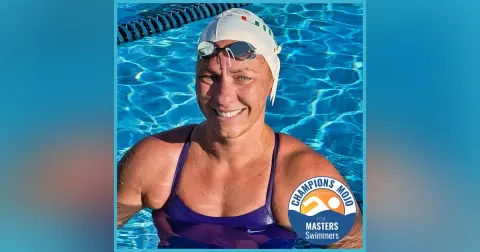
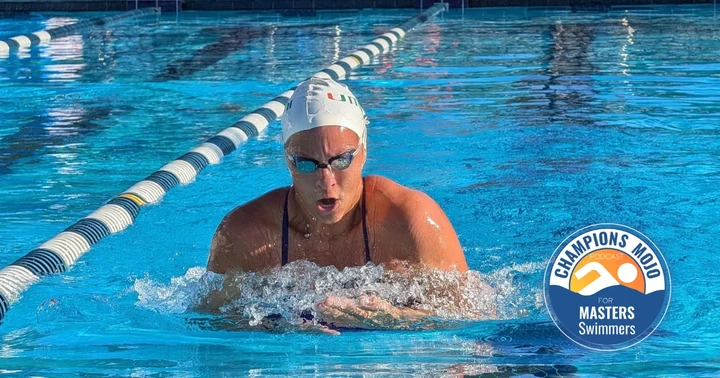
A 20-year break doesn’t have to be the end of your swimming story. Kelly catches Christina Campfort right on deck for a high-energy chat that hits on something a lot of former swimmers quietly wonder: can you really come back and race fast again after life happens? Christina’s answer is loud and clear. She’s 44, a firefighter and driver engineer, a mom with a newborn, a former college swimmer at the University of Miami, and she recently returned to masters swimming and won four national titles at the YMCA National Championships.
We talk about the messy, honest side of being a swimmer: loving the thrill of racing while dreading practice, quitting in high school, returning for a breakthrough season, and later realizing that talent can only take you so far without consistent work. Christina shares how boxing reshaped her work ethic, and how that mindset now fuels her approach in the pool. If you’re looking for masters swimming motivation, sprint training ideas, or a realistic way to train around a demanding job, her low yardage, high intensity focus on speed, tempo, and timing will land.
Christina also opens up about life in the fire service, including years in the inner city, the transition to an airport station, and the safety discipline required on taxiways and runways. We connect the dots between athletic training and high-stakes work: staying calm, staying sharp, and showing up prepared. Then we look ahead to her next target, the Police and Fire Games and the World Police and Fire Games in Australia, where she already has her sights set on the competition.
• getting back into masters swimming after a long break and finding the right practice group
• swimming at the University of Miami, shoulder surgery, and stepping away from competition
• loving racing, hating practice, and what she would change about her younger work ethic
• building a masters training plan around shifts with low yardage, high intensity sprint work
• life as a firefighter and driver engineer, including the move to an airport station
• staying safe on taxiways and runways by assuming mistakes can happen
• using swim discipline to handle fire academy and medic school demands
• setting goals for the US Police and Fire Games and the World Police and Fire Games
Subscribe for more stories that help you live well and swim well, share this with a friend who “used to swim,” and leave a review if the conversation sparks something in you. What goal would get you back on the starting blocks? Let us know....
Email us at HELLO@ChampionsMojo.com. Opinions discussed are not medical advice, please seek a medical professional for your own health concerns.
You can learn more about the Host and Founder of Champions Mojo at www.KellyPalace.com
00:01 - Welcome To Champions Mojo
01:09 - Meet Christina Campfort On Deck
01:50 - Swimming Background And Long Break
02:58 - Love Hate Swimming And Work Ethic
04:50 - Masters Training As A Sprinter
05:41 - Firefighter Life And Airport Station
07:07 - How She Chose The Fire Service
08:23 - Airport Safety And On Tarmac Risks
09:53 - Swimming Discipline On The Job
11:01 - Goals For Police And Fire Games
12:25 - Wrap Up And Review Request
Hello, friends. Welcome to the Champions Mojo podcast, where we bring you interviews and topics to help you live well and swim well, conversations especially meaningful for master swimmers and anyone striving to perform better in the water or in life. We're here to champion you. And now your host, Kelly Pallas.
Meet Christina Campfort On Deck
SPEAKER_01Hello, friends. We have a great interview for you today. It's a quick post-practice interview with Christina Campfort. Christina is a master swimmer who happens to be doing really cool things. When I learned that she drives a fire truck or a fire engine, how many of us wanted to be a firefighter? She's been a firefighter for 17 years. She's also a new mom. She's been a boxer. She swam at the University of Miami. She took a 20-year break from swimming and now she's back. She recently won four national titles at the YMCA National Championships in Sarasota. It's a great interview. I hope you'll enjoy it as much as I did. And here we go. All right. I am doing an on-deck interview with Christina Campfort. Christina, we're going to do about 10 questions. So first tell us what team you're on and how you ended up at this swim practice and how it was today.
SPEAKER_02So um recently got back into swimming masters. I swim with the Tampa Y masters typically are down in Riverview. The mornings I get off shift with the fire department, I try to make it to the um one here in South Tampa. So that's how I ended up here. I rushed off shift and came down here.
Swimming Background And Long Break
SPEAKER_01So that is so cool. I just love how master swimmers have all kinds of different professions and they still do master swimming. So what is your age and your background of swimming and how long you were off and what brought you back?
SPEAKER_02Um, I'm 44. I swim in college. I graduated in 04, so that was the last time I swam. Really, my senior year was a wash because I got shoulder surgery. So um I did some swimming when I lifeguarded down on Miami, but that was just to maintain. But yeah, swimming competitively had been since 04. And I recently got back, I think about July of last year. So it's been not quite a year. I've been back in the water. Um and yeah, what brought me back was uh wanting to do something competitive again, and I want to go to Australia next year and compete in the World Police and Fire Games, so it's my excuse to go to Australia.
Love Hate Swimming And Work Ethic
SPEAKER_01That is so awesome. So 22 years of being out of the water, you swam at the University of Miami, which I know, right? So um one of the on-deck questions is what what are you um most happy about with your whole swimming career up to this point?
SPEAKER_02Um swimming was always kind of love-hate for me. I started my first race, I think I was four years old. My sister was on the swim team, they needed another kid for the relay, and they pulled me out of the stands. My parents stole the video on VHS somewhere, so that kind of got me in. I actually quit swimming my senior year of high school. I hated it. I said I'd never swim in college. Probably the best thing my parents did was let me quit. And then I decided, oh, maybe I'll do the high school season. I ended up having the best season. Um, started getting recruiting offers, and it was hard to turn that down. So, I mean, I'm glad, you know, I'm glad I pursued it. The experience in college, being on the team and have just being a college athlete was was an awesome experience. I'd say my regret in swimming was I I liked to race, I hated practice. I could have probably worked a little harder. Um, just like I said, I I didn't love practice. I loved racing. Um, I was a sprinter, 50s, I hated hundreds. I say I joke and say I peaked at age eight because they I couldn't do 25s anymore. Um But I really I didn't have the work ethic as a as a kid. I think I got by off the talent, and I never really, I don't think, got to my full potential. Um after swimming, I picked up boxing, and that kind of made force me to work harder because you don't really have a choice. Either you work hard or you literally get your butt kicked. So I think the work ethic that I picked up when I was fighting, um, I look back thinking, man, if I would have had that work ethic when I swam, I think I would have been a little more bit more successful.
SPEAKER_01You're a breaststroker?
SPEAKER_02I did breaststroke and sprint free. Anything but backstroke.
SPEAKER_01So what is your training regimen now as a working master?
SPEAKER_02So I try to do my weight training when I'm at work, if we if I can fit it in. And then the pool stuff, pretty much any of my days off shift, I try to get in the pool. Nothing crazy though. Like I said, I'm not a big yardage person. Like I know a lot's changed in 22 years, even of swimming, and I see kind of like the new stuff some of the sprinters are doing, and I wish so that was a thing when I was swimming, because I'm like, I could do that, I could do low yardage, high intensity. Um, so I try to do a lot more just speed stuff because I really don't plan on doing much more than 50s, maybe, you know, 100 breasts, but try to kind of just focus on my speed and my speed and my tempo and my timing and everything back.
Firefighter Life And Airport Station
SPEAKER_01Yeah, as my husband says the same thing. He would have kept swimming. And really, doing 50s, that's all you need. You just need the speed work. So let's talk about you being a firefighter. So you were a boxer, you obviously you get to lift weights at work to stay strong and haul hoses and all that. How long have you been a firefighter and what what's a day in the life?
SPEAKER_02October will be 17 years. I'm currently a driver engineer, so I drive the trucks. I'm now stationed at the airport, which is nice. It's totally different type of thing than what we were doing when the people in the street basically were we just run calls at the airport, so we're on the crash, we call them crash trucks. We're there for the obviously the airplanes, and so it's a different, it's a different slower pace, but a lot of still a lot of work and training. Um but yeah, I made that little career change two years ago. I was before in station in Ybor City running calls all night and having to go home to a newborn baby, and so that that was rough, but it's a part of the reason why I'm able to get back in the pool and do what I'm doing is because now I have it a little bit easier, I'd say, at the airport.
SPEAKER_01Yeah, did so did you ever fight like b real big fires?
SPEAKER_02Yeah, I spent I spent about 15 years in in the inner city. So um, yeah, I mean I did set about seven of those on the on the ambulance, the rescue car, um, running a lot of medical calls, and then um other time on the on the engines or the ladder trucks. So yeah, got plenty of fires, got plenty, plenty of good experience.
SPEAKER_01So what made you want to be a firefighter 17 years ago?
SPEAKER_02So in college, I majored in biology. I was actually pre-vet. My goal, I wanted to be a veterinarian. The one problem I'd say beef I have with college athletics is they don't prepare you for the real world because all you do is school and your sport. So while other pre-vet students were doing internships and all this stuff to prepare for that, I graduated and realized I couldn't even apply to vet school because I didn't meet all the prerequisites. So had to reevaluate what I wanted to do. For a while, I did, like I said, I did ocean rescue just because that was a natural, easy thing to do as a swimmer, you know. And while I was doing that, um, you know, you kind of get into more of the medical stuff and knew some people that did the fire and it kind of just fit with what I liked, um, the physical aspect, the it's always changing. I hate doing the same thing. You know, I couldn't sit behind a desk and do paperwork, and I like the fact that any day is gonna be different, right? So it's always you don't know what to expect, you know, and that appealed to me. And the sk the schedule obviously is great. Um, plenty of time off. I love to travel, so um, yeah, just kind of fit naturally, you know.
Airport Safety And On Tarmac Risks
SPEAKER_01Yeah. So being a a driver or engineer, it's so cool that you're driving the the big trucks. Did you happen to see recently the fire truck that was run over by the plane where the two pilots died on the airport uh tarmac?
SPEAKER_02Yeah, so obviously, since I'm stationed at the airport, um things like that, we we did like a briefing on it with our ops and um kind of go over what what we should be doing, you know, safety stuff. Um it's it's unfortunate, and you know, you armed sure quarterback, like could anything been done differently?
SPEAKER_01Um could it?
SPEAKER_02Uh it's hard to say. I mean, I know I'm fairly new out there, so I I'm I'm very cautious. I know some people probably get a little more comfortable, um, but anytime I'm out on what what we call the movement area, um, you know, the the taxiways, the runways, um, I operate under the assumption that um the people in the tower can they can mess up. They're human. So, you know, they've given us run instructions before, they've you know messed up our truck number. So I kind of always assume they're wrong. There's times they might tell you to cross or they might tell you to go somewhere and and they're wrong. So you kind of have to always be on edge and be looking, and it is totally different at night. It's like so it's it's it's a lot harder to see. Um, so yeah, you never know. I mean, as the driver, you just have to always be cautious and operating under assumption that people make mistakes and you gotta be looking out for yourself pretty much.
Swimming Discipline On The Job
SPEAKER_01Yeah. Oh, so you're you're in this life and death job. It matters everything you do every minute of every day. Is there anything that you take from your swimming experience, either historic swimming experience or your current swimming experience that you use in your job?
SPEAKER_02Um, I think it helped me a lot in the beginning. Um, both with with Fire Academy, um Medic school, stuff like that. Um, I think just the work ethic that you you obtain with doing, especially college athletics and balancing the workload of school and sport. Um a lot of that came easy to me because of that experience. Um, because I know you know people that haven't done that had that workload, they struggle. I actually did fire academy and medical school at the same time, which for some people is like unheard of. But um, yeah, and it's you know, paramilitary kind of thing with fire academy recruit class. So you get yelled a lot, you know, and most of us have had an abusive kosher too, so we're used to that. It it definitely made that whole transition easier, the just the discipline that you know, everything that I had obtained from swimming and yeah.
SPEAKER_01So, what are your goals for the police and firefighter games in Australia?
SPEAKER_02So this year is just the they have the US one, which is a lot smaller, less people obviously, because it's just the US police.
SPEAKER_01So where is that and went?
SPEAKER_02Um that'll be June in San Diego. So I'm doing that. That's a lot smaller, but it'll at least it'll kind of get me into um that scene, and then yeah, then the that following year in March will be the world, which has a lot obviously a lot more competitors because it's the world. There there is a a female that's been doing it. She's a police officer, she's from my I want to say Pembroke Pines, she's my age, and she's been doing it for shoot probably the last 15-16 years. So she's like the the lady to beat, I guess. Um, so I've kind of been eyeing her. I don't, you know.
SPEAKER_01Um She doesn't know what's about to hit her.
SPEAKER_02She yeah. So I jokingly call her my nemesis. Um, she doesn't know that I'm sure. Um, but that's that I guess would be my goal. Is um that that's who I'm shoot shooting to be because she's been kind of dominating the last you know how many years, and we do similar events.
SPEAKER_01So nice, nice. I love it. You gotta have a goal. Well, thank you so much for spending this time with me today, and we'll see you at practice next Saturday.
Wrap Up And Review Request
SPEAKER_02Um if I'm yeah, it's hard to make it to this one every every third Friday. So I'll at least be here every third Saturday after shift. Thank you, Christina. All right, thank you.
SPEAKER_00Thank you for listening to the Champions Mojo podcast. Would you consider leaving us a five star review on Apple? That's like getting a best time for us. Kelly and our team would be so grateful. See you next week for another Boost of Mojo.
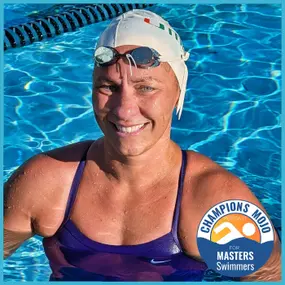
Firefighter | Boxer | Masters Swimming National Champion
Christina Campfort is a masters swimmer, firefighter and driver engineer, former boxer, and University of Miami swimmer who returned to competitive swimming after more than two decades away from the sport. At 44 years old, while balancing shift work and new motherhood, she made an immediate impact in the pool by winning four national titles at the YMCA National Championships less than a year after her comeback. Christina trains with Tampa Y Masters and brings a refreshingly honest perspective on rebuilding confidence, developing work ethic later in life, and learning how to compete with greater purpose the second time around. Her story is a powerful reminder that stepping away from the pool does not mean your swimming story is over.