

 Apple Podcasts
 Spotify
 RSS Feed
 Ironman Podium to All-American Masters Swimmer: Jane Esahak-Gage, EP 307
After 17 Ironmans, a broken ankle might not feel like a full stop, but for Jane Esahak-Gage it becomes a pivot point. After decades of pushing her body through Ironman triathlon training and racing, she gets one piece of advice that changes her path: get back in the pool. What happens next is the kind of surprise many endurance athletes secretly hope for, a return to movement that feels healing instead of punishing.
Jane brings a rare perspective as a world-class long-distance triathlete who also thrives in masters swimming. We talk about her biggest triathlon highlights, how she and her husband George built a life around sport, and the day a bike crash with a red-light runner rewrote their story. The recovery, the fear that can linger around cycling, and the resilience required to keep showing up all surface in a candid, human way.
From there, we get practical about masters swim training and why it works. Jane shares her weekly routine, why intervals and stroke variety beat endless freestyle, a favourite set for sharpening 400 IM speed, and the strength training habits that support shoulder health and durability. If you care about longevity in sport, low-impact fitness, injury prevention, and rediscovering joy in training, this conversation delivers real takeaways you can use at your next practice.
If you enjoy the show, subscribe, share it with a training buddy, and leave a review so more swimmers can find us. What’s one change that made your training feel better overnight?
Email us at HELLO@ChampionsMojo.com. Opinions discussed are not medical advice, please seek a medical professional for your own health concerns.
You can learn more about the Host and Founder of Champions Mojo at www.KellyPalace.com
00:00 - Injury Sparks A Return To Swimming
00:33 - Welcome To Champions Mojo
00:58 - Triathlon Roots And Elite Results
02:52 - The Crash That Changed Everything
05:14 - Masters Training And Weekly Volume
07:06 - Favorite Sets Strength Work Motivation
09:22 - Role Models Meet Joy And Closing
Injury Sparks A Return To Swimming
SPEAKER_01In 2019, I broke my ankle. And the doctor said, You're not going to be doing any running or biking for a while. You could get back in the pool. And when I got back in the pool, my body started feeling better. Like I've I had done years and years, like 17 years of Iron Man triathlons, just long distance, beating up my body. And when I got back in the pool, I thought, oh my gosh, this is what I'm really supposed to feel like. And I thought, I'm not ever gonna be doing those anymore.
SPEAKER_00Hello, friends. Welcome to the Champions Mojo podcast, where we bring you interviews and topics to help you live well and swim well, conversations especially meaningful for masters swimmers and anyone striving to perform better in the water or in life. We're here to champion you. And now your host, Kelly Palace.
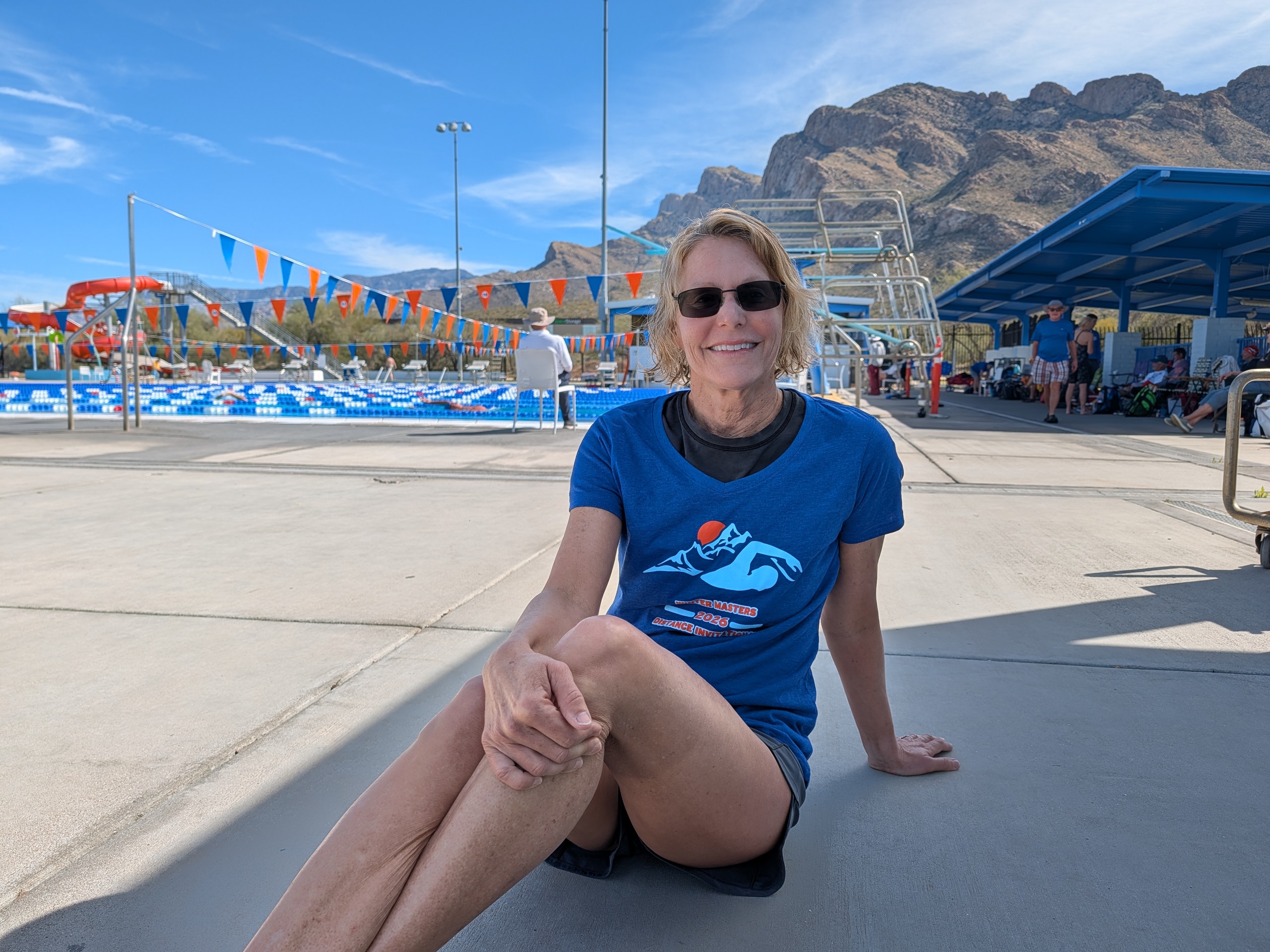
SPEAKER_02All right, we're doing an on-deck interview at the Oro Valley Aquatic Center in Oro Valley, Arizona, right? And I'm with Jane Essahat Gage. She is a longtime uh fellow competitor. Jane and I actually started together in triathlons where you just totally destroyed me all the time. But give us a little background, um, Jane. We just swam the 1500 next to each other. Of course, I did the 800, you did the whole 1500. Um, a little background on your triathlons and then how you kind of transitioned into master swimming.
SPEAKER_01Okay, so basically I grew up as a swimmer, and when I met my husband, he was doing triathlons, and I was still swimming, but I decided to start doing triathlons because I was never seeing them, and I thought, oh, I'll go run and bike with them, and that way we'll be able to spend more time together. So I started doing them in 1991, and I stopped doing them in 2019. So I did them for quite a while. And once I stopped doing triathlon, I got back into swimming and competing.
SPEAKER_02And you uh did triathlons at a really elite level, and you you do swimming at a really elite level. So what um what was your like your m what are you most your most accomplished for your biggest accomplishment for your triathlons?
SPEAKER_01So I've won the world championships in long distance triathlon in Seder, Sweden in 1999. I've been third at the ITU in Olympic distance, and I also got on the podium at the Hawaii Iron Man. So those were probably my biggest accomplishments.
SPEAKER_02Oh, only that? Wow. That's incredible. Yeah, I just always remember your name. I've always admired you from back then because I did triathlons in the 90s as well and a little bit in the 2000s. What transitioned you out of triathlons?
The Crash That Changed Everything
SPEAKER_01So we George and I were in a serious accident in 2006. We we had done like the Hawaiian Iron Man eight times in a row, and we were training for it, and we got hit by a car, and George ended up seriously hurt in the accident. He was in the hospital for like over a month, and then he had a month of rehabilitation and he lost his law profession job because he had a brain injury. But after that, I just started doing sprint triathlons. And in 2019, I broke my ankle. And the doctor said, You're not going to be doing any running or biking for a while. You could get back in the pool. And when I got back in the pool, my body started feeling better. Like I've I had done years and years, like 17 years of Iron Man triathlons, just long distance, beating up my body. And when I got back in the pool, I thought, oh my gosh, this is what I'm really supposed to feel like. And I thought, I'm not ever gonna be doing those anymore. So that's how I started swimming again. And it was 2019.
SPEAKER_02Wow. So George is here. George is always at the meets with you, kind of like my husband Mark is there at Meets, and he sent the 1500 today as you did. So the accident that you guys were in, was it together? You were both hit. Were you on your bikes? Or give a little background on that.
SPEAKER_01So we were out just on a normal training morning. It was like 10 o'clock in the morning, and we had a green light. We were almost, we were about three miles from our home in Awatuke, that's in Phoenix. And uh young kid, he was late for work and he ran a red light in his car. We were on our bikes, and it broadsided George. George flew, the car spun around, and then I flew over the car. So I I was hurt, but not like he was. He he had broke he had six surgeries, he had broken every bone from his neck down to his feet. He had compound fracture in his leg, he had major injuries. And um so that that's what happened on that day. And it took years to for him to recover from that.
Masters Training And Weekly Volume
SPEAKER_02Oh gosh, I'm so sorry. Wow, wow. Yeah, it's it's just being out on the bike is is is always a little scary. But now you are a great master swimmer. And tell us like a little bit of what you're doing now in your training as a master swimmer. What what does your training look like?
SPEAKER_01So my training is way different than it was when I was doing triathlon because when I was doing that, I just focused on swimming a lot of freestyle and just longer distance. And I really didn't do too many intervals. Now I do intervals and I really like the strokes. It's just so different from what I was doing before. And I think it gives me good variety. And so I I do intervals and George and I swim a lot on our own. And then during the summers, we swim up in Flagstaff with a team twice a week. So that basically we just make up our own workouts and do them on by ourselves or with some friends.
SPEAKER_02Yeah. So you are uh an all-American foreigner I am, or you're obviously good at distance, you're a great swimmer with swimming background. So yeah, so you're you're doing some strokes, which I think a master's coach. I think doing strokes is so important. Just it's just using different muscle groups. It's like not droning through your freestyle all the time. So how many days a week are you swimming and maybe what kind of um yardage?
SPEAKER_01So I swim six days a week, and then I try to get in around 4,000 each time I swim. And I try to do all kinds of different workouts. Maybe I'll do I always try to do some stroke every time I swim because I like that. And I don't know. I I started doing a lot more 50s and hundreds because I used to always just do distance stuff, and I I've gotten myself a little faster in the shorter stuff, but now a little bit suffering in the longer stuff because I'm doing the shorter.
Favorite Sets Strength Work Motivation
SPEAKER_02But yeah, there's it's it's a balance, right? You gotta you gotta find the balance there. Yeah. All right, so you're swimming um six days a week, about 4,000. And what would be like a favorite set? Obviously, it depends on what you're training for, but give us an event you might train for, and then a favorite set that might sharpen you for that.
SPEAKER_01Okay, so 400 IM, I like doing 50s, and I might do one hard, one easy, two hard, one easy, three hard, one easy, and do it of a certain stroke and go through all the strokes.
SPEAKER_02That's nice. That's a nice set.
SPEAKER_01How much rest on those? Uh I usually it depends on what I'll try to do my butterfly maybe on 50 seconds, and then my easy on like a minute 10. Yards? Yeah, in yards. Okay. And then backstroke, I'll just do them on a minute, breaststroke a minute, and then my free would be 45 or 50 seconds.
SPEAKER_02Nice. So how about strength training? Any of that?
SPEAKER_01Yeah, so I like to go to the gym about three times a week. But the only thing is I don't do anything super heavy because I just try to keep my muscles toned and it's more just to have some weight bearing and more for strength for swimming, but it's not like super, super heavy weights that I do. So high rep, lower weight. Yeah.
SPEAKER_02Any bands or stretch cords or rehabs?
SPEAKER_01Yeah, I I do stretch cords. I do them for my shoulders. I do a lot of the stretch cords for my shoulders, and then I also do them for my hips.
SPEAKER_02Nice. Any injuries that you've ever come other than your broken ankle when you were a triathlete?
SPEAKER_01I actually try to stay away from injuries. When I was doing triathlon, I had I had stuff all the time where I would have planner fasciitis, I would have knee issues, and since I've been swimming, I haven't had anything knock on wood. But yeah. Yeah, swimming is pretty injury-free. That's what we love. All right.
SPEAKER_02Okay, Jane, what motivates you? Like what what kind of gets you up to go to practice and go to these meets? I know you do a lot of meets, you do obviously your training a lot.
Role Models Meet Joy And Closing
SPEAKER_01I just I actually love the feeling of swimming. Like it it after you get out of the water and after you've done a hard, it's just a really I like the feeling of it. And I also like just going to the meets and talking to people and it's a social thing. So that motivates me to just keep doing it.
SPEAKER_02Yeah, I love that. What Olympians do you admire? Or if you could have lunch with an Olympic swimmer or two, who might that be?
SPEAKER_01I think um probably Katie Ledecki, just because she's had such longevity and she's been on top for so long and just been able to keep really positive. And like I said, she's been around for a long time and she's still doing well. So it's it's amazing her what she can do.
SPEAKER_02Yeah, yeah, she's she is amazing. All right, what was your favorite thing about this meet? Oro Valley, Arizona, and this beautiful mountain in the background and this beautiful 50-meter pool.
SPEAKER_01I just I like that it's a distance meet, and if even if you don't do good times, it's a great workout and fun people.
SPEAKER_02Yeah, yeah. This what this meet is low-key. It's low-key, but it's also a rare distance meet. Like well, Jane, thank you so much for spending this time with us today and wish you all the best. And it's always great to see you at Meets. Thank you.
SPEAKER_00Thank you for listening to the Champions Mojo podcast. Would you consider leaving us a five star review on Apple? That's like getting a best time for us. Kelly and our team would be so grateful. See you next week for another Boost of Mojo.
17-TIME IRONMAN FINISHER, MASTERS ALL-AMERICAN SWIMMER