World Records on an Unconventional Path: Doug Springer at 80

Some swimmers follow the textbook.
Others rewrite it.
At the 2026 Winter Masters Distance Invitational in Oro Valley, Arizona, Doug Springer did exactly that. At 80 years old, he’s still racing, still training, still working, and recently added four world records to his name at the Rowdy Gaines Classic.
But what makes Doug’s story especially fascinating isn’t just the records. It’s the way he swims.
The Strokes That Work for You
Doug describes himself first and foremost as a breaststroker. That preference has shaped the way he approaches nearly every stroke in the pool.
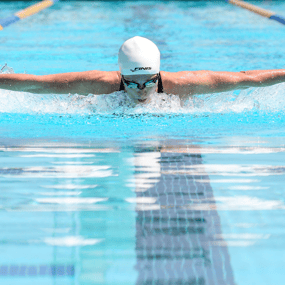
In butterfly, he uses a breaststroke kick. In backstroke, he swims a double-arm motion paired with a breaststroke kick. It’s unconventional, but it works. In fact, it works well enough to set world records.
In the 400 IM at the Rowdy Gaines Classic, Doug didn’t just break the world record. He crushed it by 17 seconds. The swim also broke the national record by 35 seconds.
For most swimmers, a 400 IM demands precision in four technically different strokes. Doug’s version shows that adaptation can be just as powerful as perfection. He’s learned how his body moves best and built a style around it.
There’s a lesson in that for Masters swimmers. The goal isn’t always to look exactly like the swimmer in the instructional video. Sometimes the real progress comes from understanding your own strengths and adjusting accordingly.
Consistency Over Complexity
Doug’s training routine might surprise swimmers who assume world-record performances require massive yardage or complicated sets.
He swims four days a week, typically covering between 2,500 and 3,000 yards per practice. The team structure includes sprint work on Monday, Wednesday, and Friday, with more distance-oriented training on Tuesday, Thursday, and Saturday. Because Doug works on weekends, he adjusts that schedule slightly and takes Wednesdays off.
The workouts themselves are straightforward. Plenty of 50s. Some odd-stroke work mixed in. Short bursts of 25s on tight intervals. It’s simple, consistent training built around what works at this stage of life.
Masters swimmers often feel pressure to replicate the programs they followed decades earlier or the workouts they see elite swimmers doing today. Doug’s approach reminds us that longevity in the sport often comes from adapting the training load rather than trying to outwork the clock.
A Lifetime in the Sport
Doug’s relationship with swimming goes far beyond his own racing. He began coaching in 1965, which means he’s spent more than six decades helping swimmers improve in the water. Over those years, he has coached age group programs, worked at the collegiate level, and even coached the Puerto Rico team at the 1971 Pan American Games.
One particularly memorable chapter of his career was coaching at Gallaudet University in Washington, D.C., a university for deaf and hard-of-hearing students. Experiences like that shaped his perspective on coaching and community.
For Doug, swimming has always been about more than times and records. It’s about helping people find their place in the water.
Building a Masters Community
In 2003, Doug founded the SaddleBrooke Swim Club in Arizona, located within a retirement community. The team has grown into something remarkable. Today, there are about 120 swimmers involved, and the average age of the group is in the low seventies.
Not everyone competes, but around 40 swimmers participate in meets. The team offers Adult Learn-to-Swim programs through U.S. Masters Swimming and welcomes newcomers who may be returning to the sport after decades away, or even learning to swim later in life.
Watching those swimmers progress has been one of the most rewarding parts of Doug’s journey as a coach.
There’s something powerful about a pool deck where people in their seventies, eighties, and even nineties are still showing up to train together. It reinforces the idea that swimming truly can be a lifelong sport.
Creating Opportunities for Distance Swimmers
Doug was also involved in launching the annual Winter Masters Distance Invitational in Oro Valley. The idea came from recognizing a gap in the typical meet format. Distance swimmers often have limited opportunities to race their best events. In many meets, the longest races are scheduled back-to-back on the same day, forcing swimmers to choose between them or attempt both with little recovery.
This meet was designed to give distance swimmers a better experience and more meaningful opportunities to compete. The first event took place in 2018, and while the pandemic slowed its growth, the organizers are continuing to rebuild it as a destination meet for long-distance specialists.
For swimmers who love the longer races, it’s a rare chance to focus on what they do best.
Redefining What’s Possible
Doug Springer’s story challenges the idea that there’s a single way to succeed in swimming. His strokes look different, his training is tailored to where he is in life, and yet the results continue to speak loudly.
At 80 years old, he’s still setting world records.
More importantly, he’s still showing up, still helping others discover the sport, and still proving that progress in the water doesn’t have an expiration date.
For Masters swimmers everywhere, that might be the most powerful takeaway. The path doesn’t have to be conventional. It just has to keep moving forward.
If you enjoy conversations that celebrate resilience and finding your own path both in and out of the water, subscribe to the show and share it with a teammate. If you have a moment, leaving a quick review helps more swimmers discover the podcast. You can also stay connected by joining our Mojo Messages, short encouraging messages sent straight to your inbox to help you live well and swim well. We’re cheering you on!
Email us at HELLO@ChampionsMojo.com. Opinions discussed are not medical advice. Please seek a medical professional for your own health concerns. You can learn more about the Host and Founder of Champions Mojo at www.KellyPalace.com
Host
Kelly Palace is proof that you can be a world-record setting Masters swimmer, bestselling author, and breast cancer survivor—and still laugh at yourself along the way. A former NCAA Division I head coach and Pfizer journalist, she now dives deep with Olympians, experts, and everyday champions on Champion’s Mojo to uncover what makes people great (and what keeps them sane)—what makes one live well and swim well. She’s survived 9/11, topical steroid withdrawal, and three divorces, yet still believes in comebacks, kindness, and coffee before (and after) chlorine. Her hobby of stand-up comedy makes her feel alive and heckled.
Training Confidence: Simone Knego on Building Belief When It Matters Most