A Broken Ankle Changed Everything—And Led Her Back to Swimming
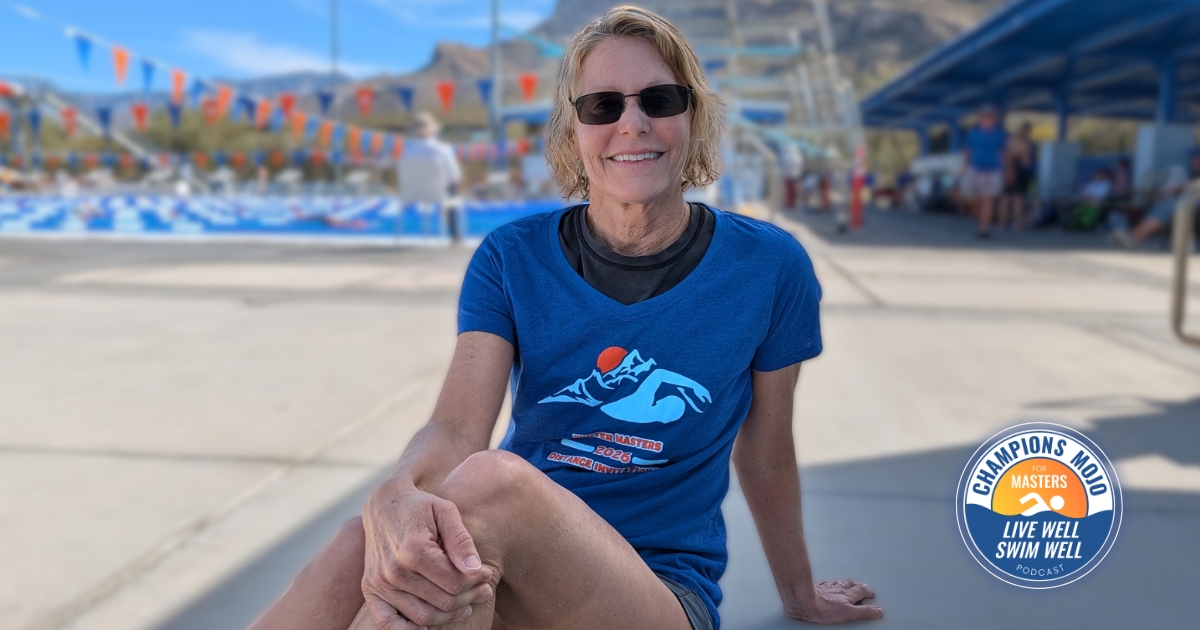
After years of pushing the limits in endurance sport, sometimes the body asks for something different. For Jane Esahak-Gage, that moment came in 2019 when a broken ankle forced her to stop running and cycling. After 17 years of Ironman triathlon training and racing, she found herself back where it all began.
In the pool.
What she discovered there changed everything.
A Return That Felt Different
Jane grew up as a swimmer before transitioning into triathlon in the early 1990s. What started as a way to spend more time with her husband turned into an elite career that included a world championship title in long distance triathlon, a podium finish at the Hawaii Ironman, and years competing at the highest level.
But after decades of long-distance training, her body had taken a toll. When her doctor suggested she return to swimming during recovery, the shift was immediate.
She describes that moment simply. After years of what felt like constant wear and tear, getting back in the water made her realize how good movement could feel again. That realization led to a decision many endurance athletes struggle to make. She stepped away from triathlon and committed fully to swimming.
The Training Ride That Changed the Path
Jane’s transition wasn’t defined by a single moment. Years earlier, she and her husband George were involved in a serious cycling accident when a driver ran a red light and hit them during a training ride.
George suffered life-threatening injuries and required extensive recovery, including multiple surgeries and rehabilitation. The experience reshaped their relationship with sport and with risk, especially on the bike. Jane continued competing, but the accident lingered in the background. Over time, her focus shifted toward shorter events and eventually toward swimming.
For many athletes, setbacks feel like interruptions. In reality, they often become turning points. Jane’s story shows how resilience isn’t just about pushing through. It’s about recognizing when a different path might be better.
Training That Supports Longevity
Today, Jane is an All-American Masters swimmer, and her training looks very different from her triathlon days.
Instead of long, steady freestyle sets, she focuses on intervals, stroke variety, and intentional workouts that keep her engaged and balanced in the water. She swims six days a week, averaging around 4,000 yards per session.
That shift has brought both physical and mental benefits. By incorporating all four strokes and mixing in shorter repeats like 50s and 100s, she has developed speed while reducing the repetitive strain that often comes with distance-only training.
Masters swimmers often default to what feels familiar, especially if they come from a distance background. Jane’s approach is a reminder that variety can be one of the most effective tools for both performance and injury prevention.
A Simple Set With Purpose
One of Jane’s favorite ways to train for the 400 IM reflects that balance between structure and adaptability.
She builds sets of 50s within each stroke, alternating effort levels in a progression that challenges both speed and control. The format allows her to push on the faster repeats while still maintaining technique and rhythm across all four strokes.
It’s a practical example of how thoughtful training doesn’t need to be complicated to be effective. A well-designed set can build fitness, sharpen race skills, and keep workouts interesting at the same time.
Strength, Stability, and Staying Healthy
Beyond the pool, Jane focuses on strength training that supports durability rather than max effort. She typically goes to the gym about three times a week, using lighter weights with higher repetitions to maintain strength without overloading her body. She also incorporates stretch cords, particularly for her shoulders and hips, to support mobility and stability.
The result has been a noticeable difference in how her body feels. During her triathlon years, injuries like plantar fasciitis and knee issues were common. Since returning to swimming, she has largely stayed injury-free.
For Masters athletes, that shift highlights an important principle. Training isn’t just about performance. It’s about building a routine that allows you to keep showing up consistently.
Rediscovering Why You Love the Sport
When asked what motivates her now, Jane’s answer is simple: she loves how swimming feels.
There’s something about finishing a hard workout, getting out of the water, and carrying that feeling into the rest of the day. It’s not just about times or results. It’s about the experience itself.
She also values the community that comes with Masters swimming. The conversations on deck, the shared effort in practice, and the connections built at meets all play a role in keeping her engaged. That combination of personal satisfaction and social connection is what keeps many swimmers in the sport for the long term.
A Different Kind of Endurance
Jane’s journey from Ironman podiums to Masters swimming success reflects a broader truth about endurance sports. It’s not about how far or how hard you can push. It’s about how long you can stay connected to movement in a way that feels sustainable.
For Jane, swimming provided a way to continue competing at a high level while also feeling better physically. It allowed her to shift from a model of constant strain to one of balance and longevity.
Progress doesn’t always come from doing more. Sometimes it comes from doing things differently.
If you enjoy conversations about longevity in sport, smart training, and rediscovering joy in the water, subscribe to the show and share it with a teammate. If you have a moment, leaving a quick review helps more swimmers discover the podcast. You can also stay connected by joining our Mojo Messages, short encouraging messages sent straight to your inbox to help you live well and swim well. We’re cheering you on!
Email us at HELLO@ChampionsMojo.com. Opinions discussed are not medical advice. Please seek a medical professional for your own health concerns. You can learn more about the Host and Founder of Champions Mojo at www.KellyPalace.com

Host
Kelly Palace is proof that you can be a world-record setting Masters swimmer, bestselling author, and breast cancer survivor—and still laugh at yourself along the way. A former NCAA Division I head coach and Pfizer journalist, she now dives deep with Olympians, experts, and everyday champions on Champion’s Mojo to uncover what makes people great (and what keeps them sane)—what makes one live well and swim well. She’s survived 9/11, topical steroid withdrawal, and three divorces, yet still believes in comebacks, kindness, and coffee before (and after) chlorine. Her hobby of stand-up comedy makes her feel alive and heckled.

World Records on an Unconventional Path: Doug Springer at 80