Escape the Junk Yardage Trap: Why Less Volume Equals More Speed
Welcome back, Mojo Makers! If you are anything like most swimmers, you probably measure a good workout by the sheer volume of sweat—or rather, chlorine—you leave behind on the pool deck. We are culturally conditioned to believe that more is always better. If you swim 3,000 yards, surely swimming 4,000 yards will make you faster, right? Not necessarily. In fact, obsessing over daily total yardage might be the exact thing that is keeping you locked in a permanent plateau.
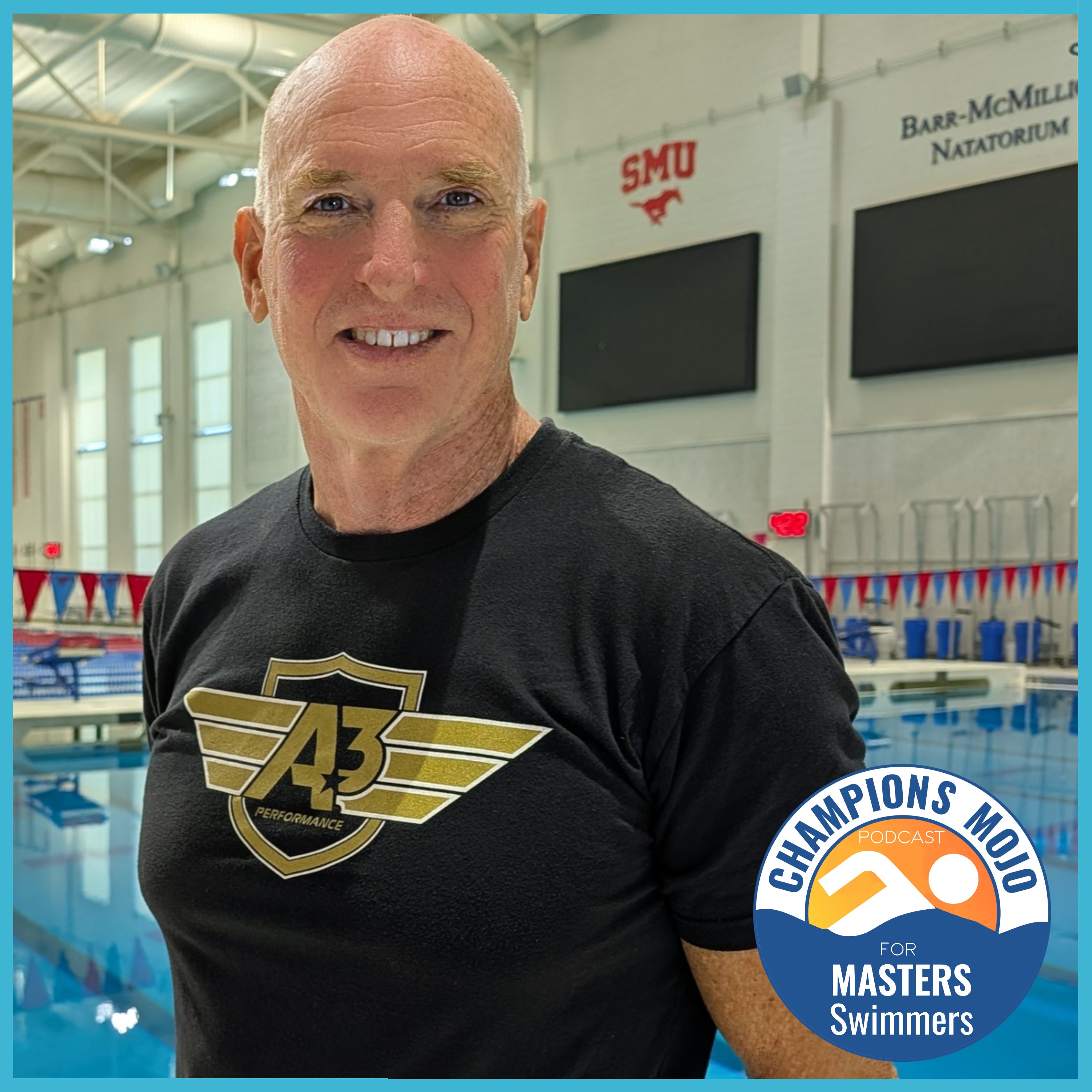
To help us unpack this counterintuitive truth, we recently sat down on the podcast with a true legend of the sport: Masters Hall of Famer and world-record breaker David Guthrie. In our episode Are Your Swim Workouts Making You Slower? with Masters Hall of Famer David Guthrie, EP 321, David breaks down why adult-onset and masters swimmers alike fall into the volume trap, and how a radical shift toward quality intensity can completely transform your speed, your health, and your longevity in the water. Let us dive deep into the philosophy of doing less to achieve more.
The Danger of the Junk Yardage Trap
What exactly is "junk yardage"? It is the miles and miles of swimming done at a grey, medium-hard pace that feels productive in the moment, but ultimately trains your body to swim slow efficiently. When you log thousands of yards just to check a box or feed a Strava stat, you are conditioning your fast-twitch muscle fibers to behave like slow-twitch endurance fibers. Worse yet, you are hammering your joints with repetitive motion under fatigue, leading to breakdown rather than breakthrough.
The trap is seductive. It feels good to say you swam 4,000 yards before 7:00 AM. It feels like hard work. But racing is not about how long you can drag your tired body through the water at a moderate pace; racing is about speed, power, and maintaining proper mechanics when the lactic acid starts screaming. If your entire training diet consists of junk yardage, your body simply will not know how to respond when you ask it to sprint on race day. To get faster, you have to stop training like an exhausted commuter and start training like a high-performance athlete.
Lessons from a Hall of Famer: The 'Teacup' Athlete Dilemma
You might look at someone like David Guthrie—who has shattered over 70 World Records and dominated masters swimming across three decades—and assume he is made of titanium. But David is the first to tell you that at age 66, he views himself as fragile as a "teacup." Like many adult athletes, he has battled debilitating injuries, juggled a demanding professional career as an architect, and made his fair share of training mistakes along the way.
The "teacup" athlete dilemma is a realization that hits every master swimmer eventually: our bodies do not recover the way they did when we were teenagers or college athletes. We are walking a fine line between fitness and injury. When you combine high-volume junk yardage with an aging, delicate frame, you are inviting disaster. David’s career proves that longevity in the sport does not come from absorbing maximum punishment; it comes from respecting your physical limitations, preserving your tissue integrity, and choosing your battles wisely in every single workout.
Quality Over Quantity: David Guthrie's Race-Pace Philosophy
So, if we are cutting back on the mindless yardage, what should we be doing instead? The answer lies in targeted, high-quality, race-pace execution. David shares his exact "bread and butter" workouts, such as his legendary sets of 4x50s, which are specifically designed to condition both the body and the mind for the brutal demands of a 200-meter race.
By focusing on race pace, you teach your nervous system how to handle speed under pressure. Instead of swimming 3,000 yards of mindless freestyle, imagine a workout where every single yard is executed with razor-sharp focus on stroke count, breakout distance, and split times. You swim fewer total meters, but the meters you do swim actually matter. You are building neuromuscular pathways for speed rather than reinforcing sloppy mechanics born of fatigue. Quality intensity forces adaptations that sheer volume can never touch.
Harvesting Low-Hanging Fruit for Real Speed Breakthroughs
Many swimmers make the mistake of hunting for marginal gains in their strongest strokes or obsessing over expensive gear, missing the massive, obvious improvements sitting right in front of them. David talks about the concept of harvesting low-hanging fruit—identifying the glaring inefficiencies in your stroke, your turns, or your underwaters that require minimal effort to fix, but yield massive dividends in your overall speed.
Often, swimmers who are trapped in high-volume training are too tired to fix their technique. When your shoulders are burning and your lungs are gasping from yard 3,500 of a mindless set, your form completely falls apart. You cannot practice good technique when you are drowning in fatigue. By lowering your volume and prioritizing freshness, you finally give your brain the bandwidth to make meaningful corrections to your stroke. That is where the real speed breakthroughs are hiding: not in the bottom of the pool, but in the execution of flawless technique while fresh.
Recovery and Longevity: The Simple Tweaks That Keep You in the Pool
Training smarter is only half the battle; how you recover determines whether you will actually make it to your next taper meet. David shared an incredible, real-world example of how a tiny, unexpected adjustment—changing his sleeping position—completely eliminated 18 months of severe SI joint and lower-back pain almost overnight.
We often look for complex, expensive solutions to our athletic aches and pains, when sometimes the answer is as simple as how you rest your spine at night or how you manage your daily posture outside the pool. Furthermore, treating your tissue health with the same respect you give your interval training is non-negotiable. Stretching, mobility work, proper sleep, and strategic rest days are not optional extras; they are the foundation upon which all future world records are built. If you want to swim fast well into your sixties and beyond, you have to treat recovery as a vital part of your training schedule.
Conclusion: How to Shift Your Focus and Escape the Trap
Breaking out of the junk yardage trap requires a paradigm shift. It means letting go of your ego regarding how many yards you log on your watch, and instead measuring the success of your workout by your focus, your speed, and your execution. Stop letting mindless volume steal your energy, flatten your speed, and break down your joints.
Take a cue from Masters Hall of Famer David Guthrie and start prioritizing quality over quantity, hunting down the low-hanging fruit in your technique, and treating your body with the care of a fine teacup. If you are ready to completely transform how you approach your training schedule and finally smash through your swimming plateaus, you need to listen to the full conversation. Check out the episode Are Your Swim Workouts Making You Slower? with Masters Hall of Famer David Guthrie, EP 321 right now. Your future self—and your stopwatch—will thank you!
Host, Founder, Journalist, Author
Kelly Palace is proof that you can be a world-record-setting Masters swimmer, bestselling author, and breast cancer survivor—and still laugh at yourself along the way. A former NCAA Division I head coach and journalist for Pfizer's magazine, she now dives deep with Olympians, experts, and everyday champions on Champion’s Mojo to uncover what makes people great (and what keeps them sane): the secrets to living well and swimming well. She’s survived 9/11, topical steroid withdrawal, and divorce, but has found love for the last 22 years with her husband, Mark, who is 12 years her junior. Kelly believes in comebacks, kindness, and coffee before (and after) chlorine. Her hobby of stand-up comedy makes her feel alive—and heckled.

Overcoming Swim Meet Panic Attacks and Air Hunger in Competitive Racing