Apple Podcasts
 Spotify
 RSS Feed
 Are Your Swim Workouts Making You Slower? with Masters Hall of Famer David Guthrie, EP 321
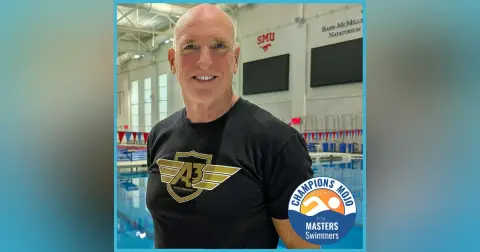
With over 50 World Records and a Masters Hall of Fame induction, you might think the average swimmer doesn't have much in common with the legendary David Guthrie—but you’d be surprised.
At age 66, he considers himself as fragile as a "teacup." He’s battled debilitating injuries, navigated career curveballs, and learned from his fair share of training mistakes. So how do you continue breaking world records across three straight decades when your body keeps trying to break down?
In this pool-deck interview from the Pegasus Masters Meet in Dallas, TX, Hall of Famer David Guthrie breaks down his exact philosophy on race-pace training, tissue recovery, and why most Masters swimmers are training completely wrong.
Inside this episode, you’ll discover:
- The Junk Yardage Trap: Why obsessing over daily total volume leads to a "glide path to stagnation"—and how to shift toward quality intensity.
- The World-Record 4x50s Set: David’s exact "bread and butter" workout to build 200m race pace and condition your mind for late-race pain.
- The "Teacup" Athlete Dilemma: Why elite adult swimmers are constantly on the verge of breaking down.
- The Sleep Position Fix: The surprisingly simple posture tweak that eliminated 18 months of severe SI joint and lower-back pain overnight.
- Harvesting Low-Hanging Fruit: Why chasing marginal gains in your best stroke is wasting your time—and where your biggest speed breakthroughs are actually hiding.
- Stingray Paddles & Life Lessons: David’s entrepreneurial comeback story and his ultimate advice on taking care of your future self.
Email us at HELLO@ChampionsMojo.com. Opinions discussed are not medical advice, please seek a medical professional for your own health concerns.
You can learn more about the Host and Founder of Champions Mojo at www.KellyPalace.com
00:00 - Why Yardage Is Misleading
00:35 - Meet Intro And David’s Records
01:29 - From Self Coached Decline To Rice
03:25 - When Hard Training Breaks You
04:40 - The SI Injury Spiral
08:22 - Racing After Injury And Record Reality
10:59 - Breaststroke Race Pace Set That Works
17:52 - Health First And Sleep Fix Via ChatGPT
20:58 - Becoming A Swimmer And Chasing Weaknesses
26:01 - Work Life Reset And Stingray Paddles
28:44 - Be Kind To Your Future Self
Why Yardage Is Misleading
SPEAKER_02
It drives me crazy a little bit. The the number one metric that everybody or most people in master swimming are concerned with is yardage. That number, it's like that doesn't tell you anything. It just tells you quantity, but nothing about quality. But that's what makes them feel satisfied or feel good. But I watch them just in a slow decline. It's like if you keep doing the same thing in a sort of mediocre space where nothing like the slow is too fast and the fast is too slow, you're just on a glide path to death.
SPEAKER_00
Hello,
Meet Intro And David’s Records
SPEAKER_00
friends. Welcome to the Champions Mojo podcast, where we bring you interviews and topics to help you live well and swim well. Conversations especially meaningful for master swimmers and anyone striving to perform better in the water or in life. We're here to champion you. And now your host, Kelly Pallas.
SPEAKER_01
All right. I am so excited to be doing an interview at the Pegasus Masters Meet in Dallas, Texas, with David Guthrie. David is an incredible world record-holding master swimmer, and he has at least 50 world records. And you'll hear my co-host, my guest co-host, who is my husband, and he's here with me. And Mark sometimes co-hosts with me. Let's just start off, David. Where are you in the world right now? And what is your swimming background?
From Self Coached Decline To Rice
SPEAKER_02
I'm in Houston. I've been there for 30 years or so. I've been swimming at Rice University since 2012. And before that, I was at the dad's club. That sort of ran its course when I mean being self-coached, we didn't this I didn't assign myself anything unpleasant. You know, those things just got taken off the menu one by one. And so I would never do like 10 200s or something. And you have to do that stuff at some point. And my performance just like declined. This is in my 40s and just sort of like the thing that kind of rescued me at the end of that was the uh super suits. So I had that sort of boost in the fantasy of this is great. But when they took them away, reality was brutal, and I was 20 pounds overweight, and which was an advantage in the suit. Suddenly, no fun, terrible. I felt like I was swimming in molasses. And the I had been breaking my first world record was I think I was 32, so I was in the 30, 34 age group, and I was breaking some records in every age group until I hit 50. And those were out of my reach for the first time. And partly because they were set in the super suit, and then I didn't have one and I was out of shape and overweight. So I had to make a change. So I s I had dropped in on Rice's workouts a couple of times and just got my butt kicked. Like I couldn't do them. And so I thought that's probably what I need. So if I want I joined their team in 2012, and that's when everything changed. And so for a couple of years there in my early 50s, I was swimming fast and what I consider fast. But I've been there ever since.
When Hard Training Breaks You
SPEAKER_02
They were just tough workouts. It was like 10, 200s and stuff like that. And it got me lean and fit. And that first year that I I jumped over there in the beginning of the year, like probably January, February, and I just skipped short course. I just trained, just trained straight through. And so that was the year it was so cool, and we had nationals piggybacked on the Olympic trials in Omaha. So it was early, it was early July. But that's where I finally got the hundred and the two hundred records for the 50-54. And wheels came off. Like everything just imploded.
SPEAKER_01
Why?
SPEAKER_02
Too much. So I started to talk about how I'm prioritizing my health over performance. If you're at your limit, you're about to break, and you will break. Every athlete, regardless of age, is on the brink of breaking. We're teacubs. That's what my massage therapist calls me. Fragile. And he's an ultra-distant cyclist. He calls all of us teacups. Okay. Because we're about to pop something. Something's about to fracture or break.
The SI Injury Spiral
SPEAKER_02
Last year I'd been dealing with a really nasty hip injury, SI problem that was limiting my training to about half of what I normally did or less. Actually, a quarter. I was doing half the number of days and doing half the number of grabs. I was like doing every other repeat. It's just all my body could tolerate. Somehow at the end of that, I started feeling better and better. The more I did less, it was like my body kind of had a chance to recover and I started feeling tapered. This is from say February till the beginning of the summer. I started, I was kind of healed and I started feeling better. The issue, the root issue, hadn't been dealt with at all. But I had learned to manage it. And my times in training were starting to be really encouraging. And I thought maybe, I mean, I thought I might be done competing, like, period. For sure last year, I thought there's no way. And I really wanted to go to Singapore. I was really excited about that. And that just got taken off the menu. Was this like a gradual onset or was it a huge situation? There was a I was jumping rope on concrete barefoot. Which is okay if you're on your toes, but I started was doing some double unders with bad form, and I'd jammed, I'd landed on my heel and I just jammed my SI. And you know, when you step off a curb and you feel that sure sharp pain. It you know, when I've done that in the past, it's like a week, it's sore, and then it's fine. And that's pretty much what happened. But it wasn't severe pain. Actually, it was pretty severe when it first happened, but you know, it kind of cleared up in a week. But that was the beginning of the summer. This is two years ago. And I hadn't been training any breaststroke. They don't assign breaststroke in our workouts. I have to take it upon myself to do it. I hadn't done any breaststroke, so it's like I need to do breaststroke. So that summer I did tons of breaststroke, and this was long course. By the end of the summer, my sacrum was hurting, and that had never happened before. I'd never had any problems with my breaststroke knees or hips or anything before. So, and I knew it was from breaststroke kick. And there's a lot going on with your pelvis and breaststroke kick, a lot of stress in that collection of joints. It's not a simple thing, it's not one thing you can isolate. And that was kind of the downward spiral. That's when it started. So you push through that pain instead of going a single physical therapy or something? Yeah, of course. And yeah, I went down to Costa Rica out to Sur. So I paddled out and I was just so tired. Like, man, this is no fun. I paddled in, I walked up the beach and I bent over to undo my leash, and it was just like an electric shock on my back. I'm like, oh no. So that was the point where it turned into like a real acute trauma. Yeah. But the underlying thing had been there for months. Yeah. And that was just like the moment it gave. And that changed my life. Man, I was old. I was like a very compromised human being. I couldn't get dressed standing up. Wow. This is bad. Now I'm scared. This cannot be my life.
SPEAKER_01
Is that this January?
SPEAKER_02
Yes. No, last January. Okay, last January. Okay. So a year ago.
SPEAKER_01
So 18 months ago. And just I just want to clarify for the listeners that you're 66 now. And so when this is happening and you say you're old, you were 64 at that point.
SPEAKER_02
64.
SPEAKER_01
So I want to go back to this meet, which you said ended up not being your most prolific meat for records because you are coming off this injury, which is incredible, the that you've just explained.
Racing After Injury And Record Reality
SPEAKER_01
How was the meat here for you?
SPEAKER_02
Okay, the meat was really positive. It's always expectations are shaped by your training. You're never gonna outperform your training. So you have a pretty good idea of where you are. And if anything, you'll underperform your training because of fatigue. If you're not rested. So I'm not rested for this meet. So I don't know what's gonna happen. And I was really hoping to get some records here. But you know, it's my first long course meet in almost a year, so I don't know where I am, I don't know how to pace, I don't know what I'm doing. You know, I'm just figuring it out. And so I was really happy with that hundred yesterday to get under the record. It wasn't a perfect swim by any means, but it showed me that I'm in a really good place. My there was only a 1.5 second difference between my first and second 50. So I didn't execute it in an ideal way, but I was really strong at the finish. So I'm really happy with that.
SPEAKER_01
Was your 200 record?
SPEAKER_02
No, that thing is a beast. That's gonna be tough. That's the I don't have any of the 200 records in this A Troop. I think I have everything else now. I have all the no, I don't have the hundred yards, but I have everything else, short course meters, but no 200s. Man, Rick Kalela's records are out there, and I'm honored to be next in line. If you take down a Kalela record, you've done something for sure. And I can I'm honored to get the breaststroke records, and I realized that's I might be able to get an IM record or two of his, but everything else, no way. I mean, he's just so good across such a spectrum.
SPEAKER_01
So, you know, when we interviewed Rick Kalilla on this podcast, he's basically never taken a day off since the Olympic Games. Did you know that? No, yeah. So all of us other master swimmers we take two years off, three years off. He said two the minute he finished, kept training. And he's basically never taken a break from swimming his entire life. And that is the most consistent person I've ever run into in master swimming, and it shows but he does take naps. He does take naps and he loves rom-coms.
SPEAKER_02
Yeah, he looks 20 years younger at least. He looks like a very fit 50-year-old and swims like one.
SPEAKER_01
I mean well, that's consistency, you know, it's showing that we've gotta keep swimming.
Breaststroke Race Pace Set That Works
SPEAKER_01
I'm I know our listeners would love to know what you do in your breaststroke training.
SPEAKER_02
There's different goals. I mean, like all training, you have to have a base. You can't just like do race pace. You have to be able to do race pace. Which is really fast for me. Like my 200 race pace, sometimes I just can't what I'm talking about is breaking it into, let's say, into 50s. My goal right now is tw is 39s. So I want all my splits to be 39s, the second, third, and fourth 50 to be 39. If I can't do a 39 and workout for one 50, that's gonna be a problem. I'm not gonna be able to do race-based training. That's where I've been for years, because I've had one injury after another, a bit compromise. So that's just kept this thing just out of my reach. Like I just I wanna I know what I need to do, I know what sets I need to do to have this performance. But I haven't been able to do them. And the mistake that I made recently was trying to work myself to that point, trying to do more and work harder to get faster. And it just took me further and further away from my goal. So the injury was a turning point in that it forced me to back off. I'm in the water six days a week and in the gym two days, three days a week. So I'm doubling up on those days. And I felt like I could handle it. And in my training, the times are solid. Like I'm very encouraged by my ability to handle it, and then I get terrible results when I go to meets. This has been going on for a few years. And then it just got to a point where I just wasn't fast enough to do my race pace. Finally, this year, this long course season, I've been able to, for the first time in 10 years probably, hold 39s on my so my bread and butter set. This is what was a turning point for me about in my early 50s when I broke records back then. When I went 227 in the 200, I was 37 on that last 50. I was going 450s on 50 seconds long course and holding 37 or better. So that was always my benchmark, always my goal. And I would do 450s and then easy 200, like real easy, take a few minutes, and do that maybe three times. That cuts to the bone. When you walk from the pool to the parking lot, you know you've spent everything. So you don't need to do a lot of that. In fact, you can't do a lot of it, like once a week, is all the body can handle. But that's my I know if I do that, that's a very reliable predictor. And this is the way it feels. First 50, it's got to be easy speed. And it might even be too fast, like 36. Then the next one a little harder. Next one is hard. 50 number three, you're going hard. And then at that wall, you are hurting, and you have to push off, and you have to go another 37 with everything that you've got. That's exactly what a race feels like. You come off that last turn, you are hurting from head to toe. But what happens is you're pushing off that wall, and you're like, Yeah, I got this. I've done this in training so many times. This is exactly the feeling in training. I'm not gonna slow down and just do it. It also makes it terrifying, you know.
SPEAKER_01
I hope people are listening because obviously you're getting results with that, and it is so important, you know, as a a coach myself that people experience that gut wrenching leave everything in the pool in practice because there's no way you can do it in a meet. Yeah.
SPEAKER_02
It drives me crazy a little bit. The the number one metric that everybody or most people in master swimming are concerned with is yardage. That number, it's like that doesn't tell you anything. It just tells you quantity, but nothing about quality. But that's what makes them feel satisfied or feel good. But I watch them just in a slow decline. It's like if you keep doing the same thing in a sort of mediocre space where nothing like the slow is too fast and the fast is too slow, you're just on a glide path to death. No, if you want to, but to talk to your point, the about two years ago, I decided I don't want to. The priority is health, not performance. And I realized like in my early 50s when I would started doing those sets, and by the way, I started doing them because our water was too hot to do normal stuff. It was like 84 degrees. So doing 10 100s was out of the question. Doing more than you know, a couple of 200s was out of the I did very few 200s in that year.
SPEAKER_01
You're talking to two Floridians where our summer water would be 92 to dangerous, dangerous hot.
SPEAKER_02
The upside of that is it's just like training at altitude. Your heart rate goes sky high, but you have to adapt. And again, we don't do a lot of breaststroke. And we had this coach who assigned, okay, we're gonna go 450s. I'm like, okay, good, we're gonna do like six rounds of four fifties with an easy 150 in between. And I was like, cool. She said, okay, on 50. And I was like, no, like this is long course. Like, I can't, how am I supposed to do that? And of course, it wasn't assigned for breaststroke, it was freestyle. And I thought, you know what? I really want to do a breaststroke set. I'm just gonna go at the back of the line and just see if I can make it. And I made the interval. I was just trying to make it, but I made four on 50, and I was like, wonder what I could do here. And that was the start of that. Nobody told me to do it. And when I yeah, I just discovered that I could hold under 39 and or under 40, and I just dropped that down as far as I could. And it was such a reliable benchmark of my performance. Like I knew if I did that set, it was gonna happen. Like I had ultimate confidence. And if I hadn't done it, I had zero confidence. It's like nothing magical is gonna happen just because you're in a meet. If you haven't done it in training in some form, you don't just suddenly have more at a meet. So you have to break things sort of like USRPT. There's a lot of good there because you're actually doing race pace. Even if it's little segments, at least your body is experiencing it. But you're not gonna just suddenly be fast because you're at a meet. You have to do that in
Health First And Sleep Fix Via ChatGPT
SPEAKER_02
training.
SPEAKER_01
Yeah, I love USRPT. So talking about health, was there anything that we missed on just being healthy? When you said now doing this for health.
SPEAKER_02
Yeah, I just prioritize function. Like I don't want to be broken, I don't mean want to be compromised. I mean, I went straight from that fixing my shoulder into this hip thing, and I eventually solved that, and I just used Chat GPT. So this had been persisting. I was just so tired of it. I spent literally a day on Chat GPT just going through all the things I could think of, like tracing it back to the origin. And you know what it was? This is crazy. I was like at the end of this conversation, I was like, well, what about sleep position? Could that be affecting it? Yes. So I had injured the right SI joint, and it wasn't painful anymore, but it was not stable. When the SI joint isn't stable, it sends a panic signal to everything around it to lock down and protect. So your pelvis gets locked. When your pelvis is locked, you are in deep trouble. So that's where I lived for a year and a half. The thing that was keeping it from healing was my sleep position.
SPEAKER_01
So what was it?
SPEAKER_02
So I was sleeping on, I injured the right side. I was sleeping on my right side. I always slept on my right side for like at least 10 years, sort of in a fetal position, usually with a pillow. And that's just the way I went to sleep, sort of curl up and go to sleep. And I would usually sleep all night like that. I was in a low-grade pain in my lower back all night long. I would wake up with a stiff, and that was the start of my day, and it go went downhill from there. So ChatGPT said, try sleeping on your left. Same position, just on your left. So that's exactly what I did. I had just started tracking my sleep a couple months before that, highest sleep score ever, that first night. Even though it felt really awkward to sleep on that side. It's like breathing on your other side when you're swimming. And then two days later, another all-time high sleep score. And the magical thing was that first night, didn't have pain during the night. I woke up with no stiffness at all. Took about 10 minutes before the gripping started. And that was just residual muscle memory. That's the pattern that your body learns. You know, it's just a reaction that's built in. So that was the turning point. And then it took a few months for my sacrum to reset and stabilize to build the strength around that again because it had been compromised for 18 months. And now it's pretty good.
SPEAKER_01
So, what about back sleeping? Do you do that?
SPEAKER_02
Yeah. So now I just sleep in all kinds of positions front, back, sides. I don't want to be habitually in any position or in any position too long. And I've got great sleep scores.
Becoming A Swimmer And Chasing Weaknesses
SPEAKER_01
Just circling back a little bit to your history. Did you swim in high school and college?
SPEAKER_02
I mean, yeah, in college, that's when I really started. I just learned to swim in New Jersey when I was a little kid. We had a 50-yard pool next door, literally next door. And so I learned to swim there and then did summer league when I was like five years old. And I think my first gold medal was 50 or 25 fly. I was a flyer originally.
SPEAKER_01
I just discovered accent strokes.
SPEAKER_02
Yeah. Then we moved to Newfoundland when I was eight years old. And I had the Speedo, it was my older brothers that swam, and that I wanted to swim, you know, it was my dream. There was no pool in St. Anthony, Newfoundland, and the water was freezing cold. So I didn't swim from eight to twelve at all. But it was a dream that persisted, you know. I really wanted to do it. Then we moved to To rural Arkansas. Well, there was a swimming pool, but it was like the country club. And so we just did summer league. And so we did across the pool, like the I don't think we didn't even have lane ropes or anything. It was that kind of thing. And no instruction, just like swim.
SPEAKER_01
So did you end up in college swimming with that background?
SPEAKER_02
So I when I learned to swim, I had no interest in being on the surface. I went straight to the bottom and did breaststroke. It was just this natural thing. And so I just could swim. That's one thing I could do all the time. Everything else was just terrible, but I was a decent breaststroker. And so through high school, I kind of leveraged that. And then it got the attention of a couple of small college coaches. And I got, I mean, I didn't get a scholarship because of a non-scholarship program, but got recruited to swim in college. And I mean, I was 108 going into college in the 100-yard breaststroke.
SPEAKER_01
What did you walk out as?
SPEAKER_02
59, like two years later.
SPEAKER_01
That story just proves my theory and the theory that breaststrokers are born. They just, I really believe that breaststrokers are generally born. You can get a decent breaststroke, but it's those little kids that you just see out there, you know, like Lily King just falls in the pool and like bobs along.
SPEAKER_02
There are definitely there are natural breaststrokers, but everybody can learn it. Oh, yeah. And I didn't know this until I started coaching when teaching. But I figured out how to teach breaststroke and it works. Like people look like breaststrokers, and pretty quickly. I look, I grew up in a time like when I was in college, you're a breaststroker. Everybody's had to specialize. And coaches like just would write off everything else, wouldn't even spend any time on it. It's like we really thought we were specific things, and we're seeing now that that is not true. The kids today are good at everything, they're having trouble picking their best event across the whole, pretty much the whole spectrum. So that's one of the beautiful things about master swimming. It's like, oh, anything's possible. I can be a backstroker if I work on it, if I learn how to do it. So it's a technique sport.
SPEAKER_01
Yeah, I I totally love that. That it's even a cool thing that you might have been pigeonholed as a breaststroker or a distance freestyler. And then you figure out this is a game I'm gonna do my whole life. Like, why would I only swim distance free for the rest of my master's career? You know what? I'm gonna try 200 breasts. I'm gonna try, and I love that for all of us, for newbies and for elites that you've just never given that event a chance. So try it.
SPEAKER_02
Yeah, another part of that is that we tend to focus on our strengths. We just keep doing hammering on our strengths. Well, you can invest a lot of time and energy and get very, very marginal improvement once you're already good. The low-hanging fruit is what we're not good at. So if you want to improve, what are you weak at? For me, it's like backstroke.
SPEAKER_01
Are we gonna see you pursuing backstroke?
SPEAKER_02
Yeah, yeah, yeah. I mean, I'm uh I'm an I ammer. I had the fastest backstroke split in the hundred I am at nationals of the field. Amazing.
SPEAKER_01
Wow.
SPEAKER_02
That's but no, I work on everything and I, you know, I really enjoy working on the weaknesses, you know, and just figuring out, okay, what am what can I do better? And this is across the board. Like, where am I weak? I know I can physically get stronger. So my philosophy is I'm not slowing down as long as I have weaknesses that I can address. Okay, maybe I am slowing down, but that's how you minimize it. It's not by trying to get better at what you're already good at, it's by getting better at what you're not good at.
SPEAKER_01
Yeah, I love that. Okay.
Work Life Reset And Stingray Paddles
SPEAKER_01
David, so how have you fit swimming into a very busy businessman who is, from what I understand, an architect? So tell us a little bit about your work schedule and how you fit swimming into that.
SPEAKER_02
Yeah, I'm in a different stage in my life. And the pandemic was kind of a turning point because I lost everything. Lost, I mean, I didn't lose it all my possessions, but I lost my work. And it was probably the best thing that ever happened to me, really. I mean, I don't really want to go through that again, but it was fantastic. I learned gratitude in a way I had never felt before.
SPEAKER_01
Was that the toughest thing you've ever gone through?
SPEAKER_02
Probably, yeah. Yeah. It was white knuckle for months and months and months. One is I had a sense of relief. When architecture went away, and I was like, whoa, I didn't expect that, and I didn't know what to do with it. It's like this is my purpose in life. And all of a sudden, it's a relief to not have to do it anymore. So I had to recalibrate, figure that out.
SPEAKER_01
A little bit deeper on that? Like, what does that mean when you lose your purpose that it was a relief?
SPEAKER_02
It was I never allowed myself to ask, do I really want to do this? Yeah.
SPEAKER_01
That's deep. Yeah. So now what is a day in the life?
SPEAKER_02
I'm just devoted to one client now, and he's a good guy, so I think I'm in a good place. And so we're our pace is what my pace is, and it fits his needs. So I'm not grinding anymore. I'm not doing that anymore. So it's yeah, it's kind of a dream life right now. I get to swim. I've got this client who's supportive of my swimming.
SPEAKER_01
So pre-recording this, we were talking about you having some entrepreneurial endeavors.
SPEAKER_02
In the mid-90s, I was swimming at the dad's club, and the coach there was Mark Border, great coach, and he had these hand paddles, stingray hand paddles. And that's what we used as a team, and I just loved them. He kind of ran into some problems with the business, and so the company was available, kind of sitting there, and I was like, Well, I'll buy it from you if you're it's for sale. And so we made a deal, and so I bought the molds, and so they're thermoformed. And that's the real that's part of the real secret to why they work so well. But I love these paddles and and now I'm making them where do we get them? The stingray paddles on Instagram, so you can get them that way. Yeah.
SPEAKER_01
Nice. Okay. We really appreciate
Be Kind To Your Future Self
SPEAKER_01
you spending all this time. The very last question is always is there anything that we have not asked you that you would like to share with the listeners?
SPEAKER_02
Take care of your future self. Be kind to your future self, plan for your future self. It will get here, and your future self will be very thankful.
SPEAKER_01
I love that. I love that. Thank you so much for spending this time with us today.
SPEAKER_02
Thank you so much, David Guthrie. My breaststroking idol. There are other better ones out there, but thank you. What a pleasure. That was awesome. Thank you so much, brother. That was cool. Very fun.
SPEAKER_00
Thank you for listening to the Champions Mojo podcast. Would you consider leaving us a five star review on Apple? That's like getting a best time for us. Kelly and our team would be so grateful. See you next week for another Boost of Mojo.
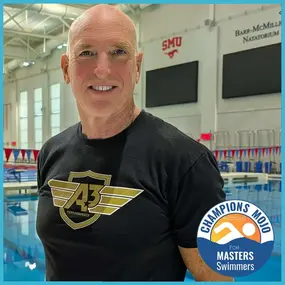
Masters Hall of Famer & World-Record Swimmer
David Guthrie is a Masters Swimming Hall of Famer with more than 50 World Records spanning three decades. At age 66, David continues to compete at an elite level while navigating injuries, recovery, and the challenges of training as an aging athlete. Known for his focus on race-pace training and quality over quantity, David has developed a unique approach to staying fast while taking care of his body. He is also an entrepreneur and the creator of Stingray Paddles, bringing lessons from his swimming career and business journey to help others perform better in the pool and in life.