Apple Podcasts
 Spotify
 RSS Feed
 Shattering the Age Barrier: How a 5'3" (160cm) "Underdog" is Obliterating World Records at 65 with Jeanette Brits, EP 322
Are you worried that your best performances are behind you? Do you ever step up to the blocks—or walk into a room—and feel entirely underestimated because of your age or size? Or worry that your time out of the water will prevent you from success?
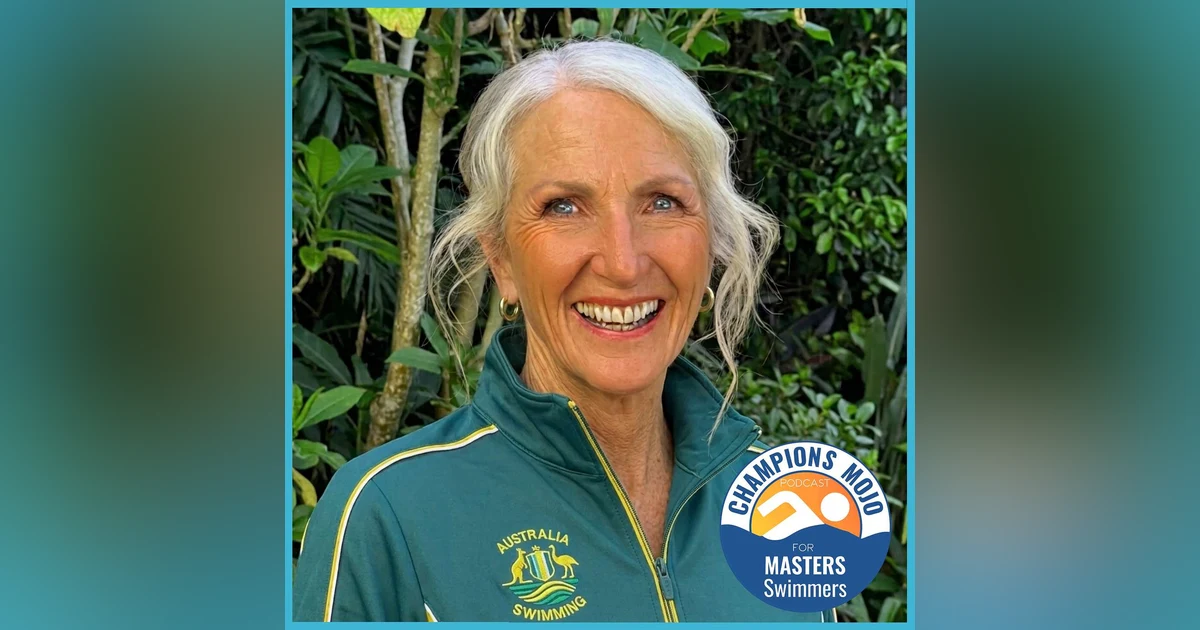
This week on Champion's Mojo, we are sitting down with a true generational talent who is completely rewriting the rules of super agers and performance in athletics. Jeannette Brits, a 65-year-old Australian powerhouse, recently did the unthinkable: she shattered the women's 65-69 age division world record in the 800-meter freestyle by almost 30 seconds, clocking a breathtaking sub-10-minute time and also broke the 200 and 400 world records as well.
But Jeannette didn't achieve this by being the tallest, the strongest, or the most naturally gifted swimmer in the water. Standing at 5'3" (160cm) and having taken a massive 30-year hiatus from the sport to raise a family and build a career, Jeannette relies on a ferocious work ethic, a "dog-with-a-bone" racing mentality, and the courage to train daily with a squad of men 15 to 20 years her junior.
If you've ever felt like the deck is stacked against you, or if you are looking for the motivation to finally make your own comeback, Jeannette’s story is the ultimate blueprint for relentless endurance.
In this episode, we dive into:
- The Comeback Blueprint: How to successfully and safely return to high-level training after decades away from your sport.
- Using Doubt as Fuel: The exact mental framework Jeannette uses when competitors judge a book by its cover and expect her to go to the back of the lane.
- Outworking the Advantage: How to overcome a lack of natural height or physical leverage through sheer grit, technical focus, and brutal consistency.
- The HRT Conversation: Jeannette's candid reality on achieving world-dominating endurance without Hormone Replacement Therapy.
- Balancing the Grind: How mixing grueling 27km pool weeks with joyful, soul-filling ocean swims keeps injuries and burnout at bay.
Tune in to discover why it's never too late to get back in the water, toughen up, and completely surprise yourself.
If you loved this episode, please consider leaving us a five-star review on Apple Podcasts— more masters swimmers can find the show.
Email us at HELLO@ChampionsMojo.com. Opinions discussed are not medical advice, please seek a medical professional for your own health concerns.
You can learn more about the Host and Founder of Champions Mojo at www.KellyPalace.com
00:00 - Loving Being Underestimated
00:25 - Meet Jeanette Britz
02:28 - Winter Pool Training Outdoors
03:49 - South African Roots And Coaching
07:13 - Australia Move And Olympian Son
08:18 - Returning To Swimming At 60
11:49 - The Meet Where Records Fell
15:49 - Why Practice Times Matter
16:48 - The Brutal 10x400 Sunday Set
18:46 - Weekly Schedule And Strength Work
21:29 - Australian Masters Seasons And Meets
24:46 - The 1000-Point Record Benchmark
29:10 - Open Water Habits And Ocean Joy
31:11 - Weekly Volume And Injury Reality
32:10 - HRT, Bone Health, And Choices
33:29 - Mindset, Technique, And Clean Eating
34:41 - Yes, Racing Still Hurts
35:16 - Two Goals To Keep Forever
36:14 - Five-Star Review Request
Loving Being Underestimated
SPEAKER_01They might judge a book by its cover and think, oh, this is this is a 65-year-old woman. She needs to go to the back of the lane. Do you ever have that happen?
SPEAKER_02I love that. I love being underestimated. That's absolutely yeah, it's just the best. So I pretty much stand on the sand before the race thinking you should be beating me, but I'm just gonna give you a hard time to see if I can.
Meet Jeanette Britz
SPEAKER_00Hello, friends. Welcome to the Champions Mojo podcast, where we bring you interviews and topics to help you live well and swim well, conversations especially meaningful for master swimmers and anyone striving to perform better in the water or in life. We're here to champion you. And now your host, Kelly Palace.
SPEAKER_01Hello, friends. We are thrilled to welcome a true powerhouse from Down Under to the show today, Jeanette Brits, representing the Manly Masters Swimming Club in Sydney, Australia. Jeanette is a former South African national swimmer turned open water champion and multiple masters world record holder. Just recently at the Australian Masters Spring Nationals, Jeannette redefined what is possible in distance swimming, shattering multiple world records in the women's 65 to 69 age division, including a breathtaking sub-10-minute 800-meter free that dropped the world mark by almost 30 seconds. From conquering Sydney's iconic ocean swims to leading the charge in pool endurance, Jeanette brings an incredible blend of humility, fierce competitive drive, and lifelong aerobic mastery. Whether you're chasing personal bats or looking to build relentless endurance, you're gonna love the deep dive that we're gonna get today with phenomenal Jeanette Britz. Jeanette, welcome to Champions Mojo.
SPEAKER_02Thank you so much, Kelly. Thank you for inviting me to have a chat. And I also want to congratulate you and thank you. You're an absolute trailblazer yourself. So thank you. Right back to you.
SPEAKER_01Oh, you're so sweet. And I I I definitely am fangirling here to get to talk with you. And I'm I'm so looking forward to this conversation. I thought what I think is really exciting is that it is 7 p.m. my time, and it's 9 a.m.
Winter Pool Training Outdoors
SPEAKER_01your time. Did you swim this morning? Absolutely. Yes. Why don't we start there? What was your swim this morning?
SPEAKER_02I had a I've got an amazing group of men. I call them young men. They range from 40, most of them are in their 50s, so quite a bit younger than me. A fantastic bunch who come from all sorts of different backgrounds: channel swimmers, pool swimmers, water polar players, triathletes. And I have this amazing base group who I swim with. And we just love our sessions, and that sets up the day for us. Now, was this morning in the pool or in open water short course, long course? Where what was it? Long course in the pool. It's an outdoor pool, Kelly, that we swim in mainly, 50-meter outdoors. It's quite challenging the long course versus the short course training, but it really sets up an amazing base.
SPEAKER_01For sure. Now it's winter down there, though. You're you are actually wearing a parka and a turtleneck. I'm in a tank top. We're in opposite seasons. So when you're training outdoors, how cold is it?
SPEAKER_02The air temperature is was roughly about eight degrees this morning, but the pool temperature is really good. 26 roundabout there, 25, 26 degrees.
South African Roots And Coaching
SPEAKER_01What I'd love to start with is you were on the South African national team. Tell us a little bit about that, what your best events were when you went from South Africa to Australia and you took a break and then came back. Give us just a little history on that.
SPEAKER_02Okay. I grew up in a small town on the east coast of South Africa. The Cape is right at the tip of Africa, and Durban is up the west coast. And the little town I grew up is probably exactly halfway between the two bigger cities. I had quite a I came from quite a swimming family, but my siblings were quite a bit older than me. And I think it was quite a relief for my mom to get me into swimming and have have a bit of break time. And I was lucky enough to have a really fabulous coach when I was very young. I started probably around eight or ten years old. And in fact, with very close links to the states, because the son of my original coach became the Alabama coach and also spent many years as a technical director on the USA Olympic team. So his name's John T. Skinner. So his dad was my original coach. And back in those days, you had a day job and then you coached in the mornings and the evenings. But he was such a technical fanatic. So I swam really badly to start with, and he just persevered with me to correct my stroke and probably set me up for life. So I owe him all my thanks, Doug Skinner. Yes, Johnti's dad.
SPEAKER_01I'd love to talk about your technique and how much you spend on that now, et cetera. But I want to I want to ask about your events that you did swim when you were on South African national team. Was it distance free or free?
SPEAKER_02It actually wasn't distance free, Kenny, because coming from a small town, we didn't have heated facilities. So our season was quite short. So although I swam up to uh a 400 in our national events, uh focused mainly on the one, two, and four, which probably wasn't ideal as I'm not the tallest sort of or strongest girl out there. So I also did quite a lot of butterfly, which Doug Skinner got me onto. And 200 Fly and 200 Freestyle, I would probably say, became my main events through my through those teenage years. And I was on the South African team from about the age of 14 for about five years. Unfortunately, after those five years, I then got on with other aspects of life with a lot of study and that type of thing. So the swimming started to take a little backseat, probably way before it should have. I see, yes. And when did you arrive in Australia? Arrived in Australia in 1994. So I've been here a long time now, been here 32 years, and feel very privileged. Obviously, heartbreaking to leave South Africa, but we made that decision in terms of we had a very young family, and I had a brother who lived over here in Australia, but still heartbreaking to leave family behind.
SPEAKER_01All right.
Australia Move And Olympian Son
SPEAKER_01So a little-known fact, your son Grant was an Olympian for Australia. That is so cool. How did that come about?
SPEAKER_02Yeah, when we got to Australia, my kids had just turned three and six, and we got him into swimming as soon as we could. It's just a life skill that I insisted on. I didn't insist on the sort of competing aspect, but he swam throughout and enjoyed it and was lucky enough to qualify in the 4x200 relay for Beijing. So although there was never an option for myself to head towards or even experience or see an Olympic Games, it was such a thrill to be able to get there and watch and just feel the atmosphere. And of course, Michael Phelps was just blazing through everything at that time, and it was absolutely thrilling. Yeah.
SPEAKER_01That that's probably even better than doing it yourself, I would imagine. That is so fantastic. So you are you took all those years off, raised your family, came to Australia.
Returning To Swimming At 60
SPEAKER_01When did you get back into swimming yourself?
SPEAKER_02We about six years ago, Kelly. Just the family had it, not myself, but had a few health challenges, and just caused a whole reset and mindset of what was needed in life. My husband and I both had quite intense jobs and we worked long hours and worked very hard. And besides, the the kids were adults by then, obviously, but it was just a complete reset for us and a restart and big decision-making changes. And we were lucky enough to retire and stop work around about 60. And that's when I started having the odd swim in the pool again and the odd swim in the ocean, and just realizing and remembering again that beautiful feeling of being surrounded by water.
SPEAKER_01Yes, and I think this would be a good time to share with our listeners just how elite your times are. I know them tremendously well because I swim your events. We're in the exact same age group. And knowing again, my listeners know my background in swimming. I swam the U.S. Olympic trials in 1984. I was an NCAA All-American. I've swum my whole life. I've been very elite as a swimmer. And I broke the 800-free record in our age group before you, three months before you. And I beat Laura Vall's world record. And everybody knows Laura Valls. She has 500 world records. She is, you know, probably the most decorated master swimmer in the world with those world records. I broke her record by 15 seconds. And then you broke my world record by 30 seconds. And that is just, I'm so thrilled to see that because my motivation is always if anybody's doing it, then everybody can do it. I just feel like if Jeanette can do it, I can do it. If so-and-so can do it, then we can do it. It's just an inspiration to see people doing it. And yet I'm I love this term super agers, like people that are just really aging at a place where most people aren't. And it's a little bit of a wake-up call to be turning 65 this year. And but to see a sub-10 minute 800, I think it no matter what age people are when they're listening to this podcast, it is so elite. It's so incredible to you basically went 455 in the 400, which is in itself a world record, and then came back in five minutes, which is another incredible time. So were these times, and then you also set the world record very solidly by maybe seven seconds in the 400 and broke Laura Val, who's more of a sprinter a little bit in the 200. Were these surprising to you, Jeanette? Were they was it shocking? Did it feel easy? Was it a goal? Was it just, oh wow, I didn't even know that. Tell us about that meet this spring where this was just an off-the-charts swim.
The Meet Where Records Fell
SPEAKER_01And I wanted to talk with you. Whether you'd been a 40-year-old male or an 80-year-old female, it didn't matter. This was just one of those magical performances by a master swimmer that we just want to hear about it. What went into it? What was it like? And give us all the details.
SPEAKER_02Okay, Kelly, I'll start with I'll start with the training. In fact, I'm not particularly tall, I'm not particularly strong, and I don't view myself as particularly talented. So my only fallback is to work really hard in the pool. I I try and just toughen myself up in the pool as much as I possibly can, and that sits in the back of my head to give me a bit of confidence. If we jump forward to nationals, I do, I am aware of times, but I also don't particularly chase one set of times. I love trying to be on the radar of where I'm trying to improve everything the whole time. So my my whole theory is if you're not learning something new every day and you're not trying to grow yourselves no matter how old you are, then you've got to take another little look, right? So the times for me, I love to achieve good times. It's an absolute thrill. And I love surprising myself. And the times that I was able to swim were a complete surprise because I don't work around setting my goal on time. I work around setting my goal on improving my swims each time. And since coming back to the pool and since coming back to swimming in general, I find the ocean swimming a lot easier. I find the pool is absolutely nowhere to hide, as you would know. And I get quite gospy sometimes in the pool. And I found the 200 and the 400 at Nationals really tough. And look, every swim is tough, but you've got to learn from that and go through and try and figure out where you could do things a little bit better and sharpen up little spaces. So I've got lots of technical things to work on. I've got my turns aren't where they where I want them to be. My start isn't where I want it to be. And I really felt that I hadn't swung the two and the four to my particular pattern, if I can put it that way. So for the 800, I tried to just do things a little bit differently and settle myself and get find your own rhythm instead of being a little bit influenced by those swimming around you. And I think I got that absolutely right in the 800. And I think that was where it was different to the two and the four, which I had swum before. So I still feel like I'm on this amazing learning curve where each time I go into a race, I learn something a little bit more about racing and where I'm at the moment. And if I gain a time, that's absolutely fabulous. But I'm more sort of ragged myself, I'm more tough on myself as to how I executed the race. And that that would probably, I'd say that probably goes for my ocean swims as well. Kelly, it's not so much where I came or what I did, but how did I actually execute that and how can I do that a little bit better next time? I think sometimes, look, as it's just a thrill when you get a great time. But I think sometimes it can also set you up for disappointment if you're just chasing a time endlessly and you just can't quite get it for one reason or another. And I don't ever want that to be a demotivating factor.
SPEAKER_01That's
Why Practice Times Matter
SPEAKER_01beautiful. Now, so if you are swimming practice times and you're fortunate enough to have a 50-meter pool there, the Spring Nationals were short course meters, but do you target times in practice? It's very easy to look at, say, an 800 and say, okay, the world record is X. And if I'm in practice every day, if I'm holding 38s or 39s just easily, then I should be able to hold that for an 800 or a mile or whatever. But do you know your practice times and target those?
SPEAKER_02Ah, definitely. Practice times are really important, and that that's my bread and butter base of everything. And the men I swim with are just wonderful, and but they're tough. They're an absolute laugh, but they're really tough and challenge me all the time. And the sets are really tough.
SPEAKER_01Give us one of your give us one of your typical sets or favorite sets.
The Brutal 10x400 Sunday Set
SPEAKER_02I'll I'll just give you. We we vary our sets a lot. We work on quite a different sort of patterns, but I'll give you one example. Sunday morning is always the same. 6.30, there are 10 400s, and we descend them from starting three on six minutes. We get to get down the next three on 545, and the next three is 5.30 or sub that, trying to end up on the last one at around 510, somewhere around there. And it's brutal, absolutely brutal every Sunday, but it's your real base confidence builder as well. You're just trying to hang in with those sort of sets. The men I swim with, the I would call him the leader. He's a channel swimmer, and there's not a lot of rest in his sets. And obviously, some days you need to do the sets where you're having plenty of rest and more sprint work and aiming at speed. But those non non-rest sets, I'll call them, really set you up for those longer distances and give you a lot of confidence in building time and time awareness in those sets. So definitely, definitely targeting time all the time. Everything's very time-driven in the pool. And I have altered, I used to swim probably four days in the pool, two or three days in the ocean, and I've altered that a little bit this last year. I've gone more, I've geared it more towards the pool. So I'm probably doing four, even up to five, five sets in the pool at least, and then a couple of ocean swims. Having said that, not every session is intense. Because I have noticed the years do creep up and you do need those recovery sets. But every set's definitely an adventure and a challenge in some way or other, Kelly.
Weekly Schedule And Strength Work
SPEAKER_01What does the week look like? So you've got four or five pool swims and then a couple of ocean swims. Are you doing any strength training or other mobility work or calisthenics?
SPEAKER_02So I'm trying to become more overall strong, if that makes sense. And I've started doing and started learning a few little exercises in the gym that are helping me a lot with that. So hopefully there's always room for improvement and always room for learning, but that's the goal at the moment to get a little bit stronger. So you're going to add that or you have added strength training? Just starting to add that now, Kelly. So yep, that's coming into it. And I hope to have a better overall base of that by next year.
SPEAKER_01Yeah, I think that's important for everyone, no matter whether you're a swimmer or not. So you're uh the guys that you swim with, we opened with that, and I wanted to. Are there just no women in the area that can keep up with you guys? Or is it just like, why is it just guys? Why is it just young guys?
SPEAKER_02Often they're there, young daughters often join us and other women, and they're definitely other women. I'm just talking about the core group, but they do swim quite fast, and it is quite a hectic pace. So the majority of the squad I swim with is definitely male and some younger females as well.
SPEAKER_01So do they just are they just blown away by your speed and endurance? Do they are they just wow, I cannot believe that.
SPEAKER_02They're very complimentary, Kenny, but they also just treat me like one of the boys.
SPEAKER_01Yeah. I I so I know I've traveled a lot around the US and gone dropped in on different masters swimming programs. Do you ever do that? Do you ever drop in on a different master's group and they're surprised because they might judge a book by its cover and think, oh, this is this is a 65-year-old woman. She needs to go to the back of the lane. Do you ever have that happen?
SPEAKER_02I love that. I love being underestimated. That's absolutely, yeah, it's just the best. So you've you're quite correct in that manner. And that's why also in these ocean swims, I think one of your questions did around beating a couple of folk that are younger than me. I don't even think about that, but pretty much stand on the sand before the race thinking you should be beating me, but I'm just gonna give you a hard time to see if I can.
SPEAKER_01Yeah, I love it. I absolutely
Australian Masters Seasons And Meets
SPEAKER_01love it. I I'm just interested in the Australian master swimming culture. What are your season short course, long course? Do you have a lot of meats? What where are you right now? Are you guys just where what seasons are what down there?
SPEAKER_02Just over midwinter, and I'll talk you through the year. So long course summer swims start around November. And just very roughly, we have uh masters meet roughly once a month. Months. That's just a sort of a very rough estimate. Hosting masters events is quite difficult. Obviously, it's pool space, venues, and so on. I'm not too sure. I think you guys are probably better equipped over in the US to be able to host more masters events and so on. But we find it quite difficult to get venues and just timing of fitting those meets in. So it's roughly once a month there is a meet available, but it's all over the state. So you've got to be prepared to travel a little bit as well. And sometimes across different states. Every state sort of runs their program. So there are other options if you're willing to travel as well. In winter, which is current, most of the meets are short course. The majority of the meets are all short course. And then in summer, round about starting in November, the long course meets kick in and they culminate in nationals, which is usually long course, but every three or four years, the nationals is short course, which it was this sort of autumn this year, just at the end of summer.
SPEAKER_01That's why your April nationals that you did these records in was supposed to be long course, but it was the odd-off year that it's short course.
SPEAKER_02Exactly. So next April, May, it'll be long course. That that's our main nationals time, and that'll be long course for the next couple of years. Do you have any special goals for that meet? I'm going to be a bit audacious, Kelly, and just see how far, see how close I can just get my long course times to my short course times. No, no definite times in date, but training long course. I'll just try and see how close I can get. I probably prefer the long course over the short course, but we'll see how we go. Yeah, definitely just as you age, just definitely trying to hang on and trying to keep your keep yourself tough and keep yourself going. I always say take it one season at a time.
SPEAKER_01You just never know. You just don't know. Sometimes come down to one day at a time. Yeah, sometimes one day at a time, sometimes one week at a time. So the you did not swim the 1500 short course. Was it not offered, or did you have to make a choice?
SPEAKER_02No, it wasn't offered this year, actually. So it's not always offered. I think in the states they have a far more sort of wider variety. It's very seldom that we get the chance to swim a 1500, which is a shame.
SPEAKER_01It's pretty much like that here, too, unfortunately. We don't there are not a lot of 1500s, but I think it's just people don't want to hang around for it or something. But I love it.
The 1000-Point Record Benchmark
SPEAKER_01So tell us when I looked up your stats on the Australian swimming, there was some points next to you. And it wasn't like you get points in a swim meet for getting first or something like that. Tell us about the I think it's called the endurance thousand point system. Is that something that you guys have down there?
SPEAKER_02Yeah, we have a point system in terms of they have a system where they a thousand points is basically the current world record of that event. And even the Australian Open Swimmers, all the trials that they do for Olympic Games and so on, they have that same point system and they rely on that for selection so that there's an equal base to select swimmers. So we, for example, at our nationals that pick a swimmer of the meat. If you do the same time as a world record, you get a thousand points. If you do a little bit short of that, you get so many hundred points underneath that. Or if you go above, so many above. So it's all very mathematical in terms of a mathematical formula, but it allows sort of those running, doing all the admin and running the admin side of it to be able to judge youth swimmers or open water swimmers or set trial times or qualifying times for the swimmers. So it's all based around that world record being equal to a thousand points, Kelly.
SPEAKER_01Is the world is that thousand-point world record the real world record, like the Katie Ledecki world record, or is it the master's world record?
SPEAKER_02So for masters swimming, if they're selecting a master of the meet, it would be based around masters world swimming. If it's selecting trial times or an Australian open team for the Olympics, it would be based on the Katie Ledecki record. So often we might have swimmers in various events because the Americans are so strong in their form strokes, where we might not have swimmers that qualify, even though they've come second or third in a particular race. So it's basically a benchmark to try and pull that standard up to world standard and at the same time fairly select swimmers of all ages and all degrees. Yes.
SPEAKER_01Oh, I love that. I think that is outstanding. We need something like that. Does that motivate you a little bit more?
SPEAKER_02Oh, definitely, because it pulls everyone up to such a high standard, and it's so tough for those going trialing for the Olympics and so on. And even our disability swimmers in all their disability ranks, they're also they have that same benchmark comparison to the world times in each of their different categories as well. So it really keeps you honest, it gives you that brutal reality of where you sit or not, and it just keeps trying to set such high standards, despite being sometimes in a country where the population isn't as big as other places. So it's just a real solid baseline standard. How long has that been around? Well over 20 years, I think. Oh, okay. Okay.
SPEAKER_01Definitely large, but really nice. Okay. You mentioned that a lot of Australians don't swim anything, but freestyle, is that the case and why? And are you mainly a freestyle? Do you freestyler? Do you do other strokes? Do you train other strokes?
SPEAKER_02Look, I think freestyle sort of gives the Australians such diversity. Being surrounded by water here and a lot of people involved in water leads to water polar surf life saving is a huge thing here, still water life saving, and definitely the norm to go to for training. I think our form strokes have been improving lately, but definitely the majority of my training would be freestyle. We do other strokes and keep it diverse, but for sure. I think that the trend, definitely in my case, anyways, to stay with freestyle is 90% of the session.
SPEAKER_01Yes, that's
Open Water Habits And Ocean Joy
SPEAKER_01really good. Tell us a little bit about your open water schedule.
SPEAKER_02Okay. The open water is really good, especially down here in Sydney. There are races up and down the coast and heaps in Sydney right through summer. Every single weekend, there are at least one or two races, open water races, that you can go and choose to do. So there's there's a lot of opportunities in that respect. I grew up on a sort of a beach that had pretty challenging surf at times, and I was quite involved in the surf club, and that's what all the swimmers got involved in. And so I got used to swimming in big surf quite and definitely as a teenager. I have absolute respect for the ocean, but I think the ocean gives that beautiful balance of being able to just stretch out and swim without the brakes, without the turns. There's a fantastic group called the Drinks Express at 6:30 every morning that swim across the bay, which is about a 750-meter swim. And they stand on the beach on the other side and then they race back to Manley. So it's literally a seven, 700-meter sprint as fast as you can, anyway, back to the beach, and then possibly a swim down and a coffee after that. So it's a lovely setup. There are people that do that 365 days a year, and it's just a fantastic group of people down there. So very lucky to be in that vicinity and enjoy the beautiful ocean. And it's in a reserve, so they're amazing fish and cuddlefish and stingrays and little shoals of bright tropical fish to see. So just a glorious setting. And so I love the diversity of being able to switch between the pool and the ocean and feel very privileged with that.
SPEAKER_01That swim every morning. So that's 1500 meters for that morning swim. And it sounds
Weekly Volume And Injury Reality
SPEAKER_01like your Sunday workouts 4,000. What would you say your total week in general is?
SPEAKER_02In general, at the moment, Kelly, I do about exactly 26, 27 Ks kilometers a week. So the pool sessions would all be five, except for Sunday. I usually get in a little bit early, so it puts it a little bit over four, four Ks anyway. I'm the regular 27Ks a week at the moment. I'm not too sure how long I can hold on to that because I think we do need to be adjust and be a bit flexible so that we can hang on to our body and keep our body together. Yes. Any injuries? This season was a bit of a reality check as I had a few, I had some hamstring pulls and my left shoulder is a little bit weaker than my right one, and I'm feeling that a little bit. So just working on not overdo things and don't fall over the top on the other side. Yeah.
SPEAKER_01That's
HRT, Bone Health, And Choices
SPEAKER_01beautiful. So in our age group, one of the things that we have a big discussion going here on women needing hormone replacement therapy. But I know a lot of top swimmers are afraid to take it because they're afraid people will say, oh, she's fast because she takes HRT. And it's put a little bit of a division in some of the women swimmers that I know in our age group.
SPEAKER_02Yeah. So I'll I'll answer your question very clearly here, Kelly. I do not take it, and I was never given the option of it. My medical advisors never even hinted on going down the path. I try and live life with no regrets at all, but a little part of me always wonders now should I have gone down that path? Because now you are dealing with issues of bone health and muscle deprivation and the whole list of things. So in a nutshell, no, I definitely have never ever taken anything. Amazing.
SPEAKER_01We established that you are not especially tall or you don't have six-foot arms.
Mindset, Technique, And Clean Eating
SPEAKER_02How tall are you? I'm about five foot three, five foot four. Incredible. What what do you think makes you so fast? I think I just have that maybe I have that no-give up attitude, and I'm sure you do too, Kenny. But I just find I can dig in there. I'm a little bit like a a dog with a bone. If I'm on someone's tail or if I'm trying to chase someone down, I just feel like I have a bit of the underdog status and always have. I was I never came from a wealthy home. I had to work really hard for everything I've got. My brother in Australia actually sent me my first lycra swimming race suit to race in at a nationals in South Africa. So I just feel like I grab everything with both hands. And swimming techniques, I always think about them. I think about the different sets that we do. I think about the technical aspects of how I enter the water. I love clean food. I love natural food. I love my fruit and veggies and good proteins. So just try and execute everything I can as best I can on the day and in a race, Kelly.
Yes, Racing Still Hurts
SPEAKER_01Do you hurt in a race or are you so fit that you're just swimming at what you do in practice and it's just not that painful? I hurt.
SPEAKER_02I hurt from the beginning. I go pretty hard. I'm learning to control myself a bit in the pool, but even in the ocean swims, I go out as hard as I can. So the the start of any race is the worst part for me, just to try and get myself into the rhythm and get myself under control. But no, I hurt. I hurt badly all the time.
Two Goals To Keep Forever
SPEAKER_01All right, Jeanette, I could talk with you all day, your day, my night. But is there anything that I have not asked you that you would like to share with us?
SPEAKER_02I've got two goals. It's to keep trying to stay tough and keep trying to learn. And then just on a real final note, and that I suppose is about going hard and getting out there and into the race. If you don't have a go, you'll just never know. So to all your swimmers and those that listen to the podcast, just get out there. Life's just there to have a go and absolutely surprise yourself.
SPEAKER_01Oh, I love it, Jeanette. This is wonderful. So grateful you spent this time with us today. And I know everybody's going to love hearing this.
SPEAKER_02I feel very privileged to have chatted with you today, and thank you so much for reaching out.
Five-Star Review Request
SPEAKER_00Thank you for listening to the Champions Mojo podcast. Would you consider leaving us a five star review on Apple? That's like getting a best time for us. Kelly and our team would be so grateful. See you next week for another Boost of Mojo.