

 Apple Podcasts
 Spotify
 RSS Feed
 Protect Your Knees and Hips: Helen Gorman on World-Record Breaststroke Longevity, EP 324
Key Takeaways
- Prioritize a 20-minute daily dryland routine focusing on hip, knee, and ankle mobility before entering the water to protect your joints during high-demand strokes like breaststroke.
- Maintain training consistency by committing to a regular weekly schedule—such as five two-hour sessions—rather than relying solely on sporadic high-volume weeks.
- Reset your performance baseline when returning to competitive swimming later in life by comparing yourself to peers within your current five-year age band rather than your teenage personal bests.
- Embrace training alongside younger age-group and university swimmers to stay challenged, maintain high training tempos, and benefit from a diverse squad culture.
- Incorporate race-pace 50s and targeted back-end sets to build the endurance and holding power needed for the final stretch of a 200-meter breaststroke.
Breaststroke is notorious for sidelining adult swimmers with groin, hip, and knee strain. But what if joint degradation isn't an inevitable part of competitive aging?
How do you step away from the sport for 13 years, return at age 40, and capture 13 World Aquatics Masters titles and nine individual world records—all while racing the most joint-punishing stroke on the program?
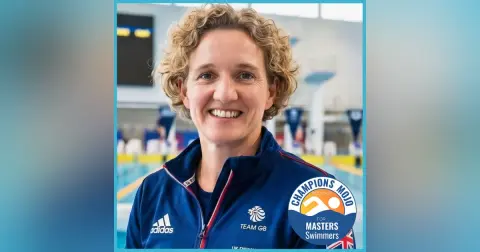
In this episode, City of Cardiff, Wales, UK, swimmer and Freestyle Media Podcast host Helen Gorman joins Kelly Palace to reveal the training routines and mobility habits that preserve joint health in the 50–54 age group. Helen breaks down why breaststrokers can't rely on in-water yards alone, how she maintains pace alongside teenagers without burnout, and the weekly volume balance required to keep joints functioning at an elite level.
Inside this episode, you’ll discover:
- The 20-Minute Joint Armor Habit: Why showing up early for mandatory dryland mobility, foam rolling, and hip activation is non-negotiable for long-term breaststroke health.
- The 13-Year Layoff Reset: How Helen avoided the frustration trap at age 40 by starting the clock over and setting realistic targets within 5-year age bands.
- Surviving "Butting Kicking with the Kids": The tactical boundaries of swimming with elite youth squads—and why Helen avoids double workouts to preserve recovery.
- The 200 Breast Back-End Blueprint: Helen’s go-to broken sets and race-pace repeats to build holding power on the final 50 meters.
- Technique Over Brute Force: Why elite Masters longevity comes down to holding water rather than muscling through fatigue.
- The UK Breaststroke Legacy: Cultural coaching insights from the home of Olympic champions David Wilkie and Adam Peaty.
Email us at HELLO@ChampionsMojo.com. Opinions discussed are not medical advice, please seek a medical professional for your own health concerns.
You can learn more about the Host and Founder of Champions Mojo at www.KellyPalace.com
Frequently Asked Questions
How do masters breaststrokers protect their knees and hips from injury?
Masters swimmers can protect their joints by committing to a mandatory 20-minute pre-swim dryland routine that includes foam rolling, stretching, and specific hip and ankle mobility exercises.
What is Helen Gorman's weekly swimming and training volume?
Helen Gorman typically swims five two-hour sessions per week, covering between 20 and 25 kilometers, alongside two to three gym sessions focusing on mobility.
How can adult swimmers avoid frustration when returning to the sport after a long break?
Swimmers should start the clock over by setting realistic targets within their current five-year age group and comparing times only with current peers rather than dwelling on past teenage personal bests.
Why do some elite masters swimmers train with teenagers?
Training alongside younger age-group squads pushes masters swimmers to maintain high training tempos, stay accountable to consistency, and avoid the over-complication sometimes found in purely adult groups.
00:00 - Meet Helen Gorman
02:10 - Returning To Racing At 40
03:58 - Training With Teenagers Every Day
08:32 - Race Pace Breaststroke And Favorite Sets
12:35 - Mobility Habits That Keep Her Fast
15:16 - Why UK Masters Swimming Is Booming
19:07 - Advice For Coming Back After Time Off
23:27 - The Hard Start That Built Resilience
25:55 - Culture Shock In US College Swimming
29:55 - What Freestyle Media Reveals About Great Masters
35:20 - Ice Cream, Budapest, And Goodbye
Meet Helen Gorman
SPEAKER_00Hello friends. Today's guest is a dominant force in international master swimming, Helen Gorman. Helen swims out of Wales with the City of Cardiff Club, and she holds four world masters records in breaststroke in the 50 to 54 age group. She is a former NCAA Division I swimmer at the University of Arkansas. Then she took a 13-year break from the pool, competing in everything from water polo to cycling, a mountainous stage of the Tour de France. She returned to competitive swimming at age 40 and has not looked back. Today she has amassed 13 world aquatics master's titles and nine individual world records, all while training alongside teenagers who keep her on her toes. On top of that, Helen has worked with major global sporting events like the Olympics, and she hosts the popular UK master swimming podcast Freestyle Media with over 200 episodes under her belt as an incredible champion for our sport. I'm so excited to talk to a fellow master swimmer, podcaster, and something else that we didn't even know we had in common. I was a swim coach at the University of Arkansas before Helen got there. But Helen, welcome to the show.
SPEAKER_01Hi, thank you very much for having me, Kelly. I'm really looking forward to this chat and uh I think it's gonna be good fun.
SPEAKER_00Yes. And um we're dealing with the time zone again. It's morning here, it's um late afternoon there. I think we're only five hours apart. But um tell us uh so far, have you have you had a swim today or what what are you what's your day been like other than uh what I know you just did?
SPEAKER_01Well, I am actually on holiday. I'm on a tiny little island in the Atlantic Ocean called Lanzarote, which is part of Spain. And I did get up this morning, I cycled to the gym. I did my Wednesday gym session, even though it's Monday, I'm two days ahead. I had a little swim down, cycled home, had a nice breakfast on the balcony, and then I've been chatting to you. It's all good.
Returning To Racing At 40
SPEAKER_00Oh, wonderful, wonderful. So I think one of the things that a lot of master swimmers are is they consider themselves swimmers, but then they become swammers. Like uh they just they had the identity as a swimmer, whether it was all the way at Division I and international team, or maybe even just a summer league swimmer, but then uh they get that urge to get back into it. What kind of drew you back to swimming? How did that happen? And how did you avoid the frustration of going back into a sport that we used to be really good at?
SPEAKER_01Yeah, well, I avoided it because I didn't intend to come back. I came to into master swimming in 2012 to avoid doing an Iron Man because all my friends, when they got to 40, would do an Iron Man. My office was above a triathlon shop, and it was so normal, it was just expected. And as a breaststroker, I have floppy knees and ankles, and I didn't want to run a marathon after cycling 180 kilometers and swimming 3.8k. I I couldn't think of anything worse. So I looked up the British master's records in my age group, they were pretty tough because most have been set by an Olympic silver medallist, Maggie Kelly, and I thought I'm gonna have a go at that, and also I'm gonna join a club to try and get my triathlon swimming back on track because I was conscious that my swimming wasn't as good as it had been. So I joined a club just temporarily and I intended to swim for six months and then go back to triathlon. So I didn't really have expectations because I didn't intend to get into it.
SPEAKER_00Oh, I love that.
Training With Teenagers Every Day
SPEAKER_00I love that. So you when you did get back into swimming, you are doing one of the things that I see a lot of really high-level masters swimmers do, which is training with the kids, as we call it. Training with the kids in the US means age group kids programs. Are you training with the age group programs? And if so, what does that look like and why are you doing that?
SPEAKER_01When I first went back in 2012, there was a pool that was about a mile from my house. I could cycle through the park to get there. There was a club, and it was quite a diverse club. It had a master section and it had an age group section, but the more serious master swimmers would train with the kids, as you say. And it was a very, very diverse club. I got there and there was a guy who was intellectually impaired, and his best friend was a dwarf, and they both competed internationally in paraswimming, and then there were some triathletes, there were some older guys that were into the gym, and there were a bunch of kids, and there were a bunch of triathletes. It was probably the most diverse swimming club I've ever been in. So there was no question about whether I was gonna fit in. And I kind of kept my head down for the first few months that I was there, and then within about three months, I really started to improve. And you know, I'd gone through having cramping both calves and both quads at the same time, of my face being bright red, getting my ass kicked by kids. But once I got through that, I did start to swim quite well, and yeah, I ended up having a great relationship with the coach there, and I would read sessions on swim swam that you know a lot of the great American breaststrokers had done. So I'd find sets that Lily King had done, and then suggest to the coach, hey, let's have a go at this. And actually, we worked really well. It was an amazing group, and I felt really lucky to be part of it. And then when I moved, moved house to Cardiff, um, I just thought, well, I'm used to swimming with age group kids and I'm gonna carry on because I enjoy it and I've been swimming well, and maybe master swimmers complain a bit too much. Kids just get on with it. So yeah, that's just the norm for me now.
SPEAKER_00And what does that look like? Like what is your your training week like?
SPEAKER_01Um, I do five two-hour sessions a week. So I swim every day. I don't do doubles, I have a couple of days off, and I do two or three gym sessions a week. And I do exactly the same sessions that the kids are doing. There is a there's a performance squad that's above the squad I'm in, and the squad I train with is a mixture of 16 plus kids and then university aid summers. There's a couple of master summers, but they don't get to come training quite as much as I do because my life is kind of organized around getting to training, whereas they're they've got more demanding jobs than I have. So yeah, it's um it's a decent mix. Um, there's no allowances for my age. I don't need them. I manage to train okay and I enjoy it.
SPEAKER_00Wow. So five times two hours, what is the meterage you cover in two hours?
SPEAKER_01Well, I do typically between 20 and 25k a week, sometimes more. So I have this thing. I haven't really been doing it this year, but um, I usually transfer a million meters in a year, which is an average of 20k a week. And that is difficult if you then take any weeks off, which we all need to from time to time, or if you taper for a meet, you're gonna go below 20k. So I try and swim a million metres, and I normally add it up on my Instagram, and I stopped doing it, and people started coming up to me at meets and saying, How's your million meters going? You've not posted, and you've inspired so-and-so to go and do a million metres, and actually we quite like hearing about it, so maybe maybe I should post about it again. But it's a mark of consistency, and I'm very much about consistency. So, for example, this year I've not swam as well as previous years, it's the last year of my age group. I've had a few things going on externally, kind of life things, but I still try and maintain that consistency of five sessions a week, and I absolutely love training, and it's just part of my day that myself and my partner work around me being at training, and you know, everything else fits in around it. So yeah, I just love to train, and even if I'm not performing, I'll still try and maintain that consistency of training.
Race Pace Breaststroke And Favorite Sets
SPEAKER_00And what would you say one of your favourite breaststroke sets is?
SPEAKER_01Um, oh gosh. Well, I I grew up on a diet of doing 1,400 breaststrokes twice a week off three minutes, and that would be hell. I mean, that's what got me to the level I got to be able to swim Division I NCAA national championships and to represent Great Britain at the World University Games twice, but I I I couldn't possibly do that now. Um I really like back end sets, so I'm a 200 breaststroker, so it's all about that final 50. So maybe 24 100s as three sets of eight, going out strong on freestyle on the first 50, and then trying to swim at back end tempo on the second 50. I really enjoy that set, but the majority of the time I'm swimming at 50s at race pace and repeated 50s at race pace, and I think that keeps you honest. You've got to be realistic about what your goal pace is, uh, and it is gonna change from time to time. So, yeah, a diet of race-paced swimming, and I just love kick. I if I could do a kick set every day, the coaches always come over to me and say, We've written this set for you and it's a kick set because no one else likes it, and I love kick. Do you kick breaststroke? Yeah.
SPEAKER_00And so you're being a breaststroker and being from the UK, I you know, I feel like Adam Peaty is kind of your most famous breaststroker that's ever come out of the UK. And on the theme of it being international, I just interviewed an Australian swimmer, and she basically said, When Australia freestyle is the premier stroke, they do a lot of open water and they're known for their freestyle relays. And she's a freestyler, ask her if she did other strokes, and she said, not really. And she said it's just not emphasized in Australia. If freestyle is the thing that's emphasized, it's not emphasized to do other strokes. Would you say in the UK that one stroke is promoted over the other, or are you guys just doing all all-round training? It seems to be that you guys are pretty well-rounded in the strokes.
SPEAKER_01Well, it's topical you mentioned the Aussies and Adam Peaty, because an Aussi just beat Adam Peatie at the Commonwealth Games, so it's funny. I mean, he's been dominant, hasn't he? And and I think there's a long tradition in in Great Britain, starting with David Wilkie. He set the world set the world record and broke uh won the Olympics in Montreal in 1976. And I interviewed his son recently, actually, who's trying to swim 215-11 to emulate his dad's world record to raise a ton of money for SportsAid, which is a charity that supports young kids coming through in the sport. So that was an interesting, interesting chat with him. But David Wilkie then set that up for Duncan Goodhue, Adrian Morehouse, Adam Petey. And I think there's just that if you want to be a good breaststroker in Britain, going under the minute on 100 free if you're a guy is it's not so there's a bar that's been set very high. But if you look at the states, you guys have had Amanda Beard, Rebecca Sonny, Millie King, Lydia Jacoby, Kate Douglas, and you know, got Gabby Rose, who I'm you know very aware of what she's doing in Masters. So I I don't know, we don't we don't prioritize brushstroke. I swim in a medley program. Most of the clubs I've swam at have been medley programs. I wish I knew what the Aussies were doing because their freestyle strokes are absolutely beautiful, but I think it's a legacy thing, and I think it does go back to someone like David Wilkie. And it's not being the same success in female brushstroke. So I don't think you can generalize and say, oh, well, in Britain we learn brushstroke over freestyle. I just think it's a legacy thing.
SPEAKER_00Yeah, and that certainly does. History does help shape the future.
Mobility Habits That Keep Her Fast
SPEAKER_00That's really great. I personally love breaststroke, and I'm wondering if you could talk a little bit about anything that you do outside of the pool. You said you have floppy knees and ankles. Uh, is there anything you do outside of the pool besides like a dry land or something that really helps you strengthen your hips and your knees and your ankles?
SPEAKER_01Well, first off, I don't think breaststrokers are made. I think they're born. I think breaststrokers just naturally are flexible in that direction. I think if I did a DNA test, I'd probably be part frog. So I think there is something about genetics there. And the the current club I'm at, we have to get to the workout 20 minutes before it starts. It's frowned upon if you are later than that. And that 20 minutes is spent foam rollering, doing stretches, doing mobility, activating the body, and a lot of that is hip and knees and ankles for everybody, even if they're not a brushstroker. Some of the guys will do more bandwork if they need to look after their shoulders. But yeah, that's 20 minutes a day. You add that up, I spin five times a week. Yeah, you've done an hour and a half of mobility before you've even got in the water. And I do gym work on top, which has a high percentage of mobility in it, and that's all year round. And my previous club, we didn't do stretching or anything before training because it just wasn't practical because we had public swimmers in the pool and we would then get in, and they just didn't want us sitting around on pool side stretching. But we would do it after the workout, and they some of those workouts would finish at 9.30 pm, and we would still have to do 15 minutes after every session of mobility. So I do think that is the reason that I'm able to genetics and the amount of mobility work I've done is enabling me to swim brushstroke as a 40, you know, 50, how old am I, 54-year-old woman?
SPEAKER_00Wow, that is absolutely fascinating. And certainly, I know you are with the kids, but a classic master's practice here is people run in and straight out of their jeans and jump in the pool. There's not a there's not even an arm swing, you know, it's just like, oh, you know, you just kind of get in and go. But you know, that is that is fascinating and certainly valuable. Obviously. I mean, I wish that I had that discipline or that group camaraderie to do it, but it just doesn't, it just doesn't get done over here.
Why UK Masters Swimming Is Booming
SPEAKER_00So let's talk about a little bit of um the state of the UK masters swimming in general.
SPEAKER_01Yeah. Yeah. So we had a bit of a crazy event in 2016. So Britain hosted the European Championships and it was in the Olympic pool in London, and nobody had had the opportunity to swim in that pool, and suddenly it was open to everybody, every master swimmer in Europe could come to London and swim in that pool. Well, every master in London in the whole of Europe decided they did want to come to London because it's an easy flight and they wanted to swim in the Olympic pool, and the event sold out multiple times over, and I think it drew out lots of people that hadn't swimmed for years, and then they got there, they they we weren't allowed to do our full allocation of events, we had to choose some events to drop out of. It was kind of carnage, but it did bring a lot of people back to the sport, and then the other thing that really has brought people back was COVID, because we were all out of the water for nearly nearly two years, and we all came back and realised we were able to still swim, even though we had two years out. And I think all those people that had been out for many years thought, hey, everyone's been out, this is my opportunity to to get in. And I think there was a lot of unfinished business for some younger master swimmers. So since 2021, there's been a huge uptake from the younger end of master swimmers wanting to compete in our national events, and they sell out in a couple of minutes. It's it's crazy, and our national championships is unbelievably fast and very, very competitive. But there's also lots of other fun events, inclusive events, regional events, club events. It's you know, it's a pretty vibrant community, and yeah, I think that at the top end we've got a lot of people that are really motivated by world records and going to the world championships and the European Championships. But uh you know, across the board, there's people that are just enjoy training and enjoy doing a few races and doing some relays. So yeah, I'd say it's pretty healthy. I don't I have heard that there are 10,000 registered master swimmers in Britain, which is a lot smaller than than the US, but you only really register if you intend to compete. So if there are 10,000 active master swimmers racing, that's a pretty big number.
SPEAKER_00Yes, that is very interesting. And so are there even though they may not be registered master swimming, registered master swimmers, are there programs uh scattered throughout the country with master's coaches and they're all under the the mothership?
SPEAKER_01Not no, not really. Um I think there are a lot of unregistered master swimmers maybe training in clubs that they know they don't want to compete. But the lower level is it's all volunteer-led, and the maybe the standard of coaching and the encouragement to get those people up to the level to want to compete isn't there. Some of the more remote parts of the country that you know you've got people regularly turning up and swimming in lanes together, but no desire to compete. Um it's not the end of the master swimming scene that I know the most about, to be honest. Um, but there isn't there isn't somewhere you can log in and you can download free programs and you can, you know, go and train and be part of a an online community, so to speak. Um that doesn't exist. And maybe it should, and maybe that would be a development, but the governing bodies are really they're wanting to look after people that actually are going to turn up to a competition and and compete. Um and then it's down to the clubs to look after everybody else.
SPEAKER_00That's very interesting. Very interesting.
Advice For Coming Back After Time Off
SPEAKER_00Um and what would you say to, you know, your best advice for a master swimmer who's been off for a while and thinks their better days are behind them, or they just are afraid to come back, what would you say to them?
SPEAKER_01Um I mean, I think you've got to start the clock again, and we've all got our best times from when we were younger. And I think if you come into master swimming swimming when you're in your 20s, maybe or even your 30s, it's a little bit too much of a temptation to base your performances on what your personal best times are. But if you're coming back when you're older, I think it's important to look at how people are swimming within your five-year age ban to only compare yourself to people that are similar to you. Don't compare yourself to your 16-year-old self necessarily. But you know, I know of plenty of master swimmers that are faster in their 40s than they were as teenagers. And my my my lifetime best time for 50 brushstroke was at age 47. And if you look at someone like Joanna Corbyn, who's got lots of world records on backstroke, a really high performer, but she gave up swimming at 16 and was quicker at 46, 47 on her backstroke races. So I don't know, we're we're we're all different, but we're not on a a gradual decline where it goes up and down, and there's going to be good times within that, and times that that you struggle. But I think if you're realistic and look at people that are a similar age to you, then remember it's a privilege to age because I'm sure you're the same as me. I've got friends that are my age that have died, and without sounding too morbid, it's a privilege to be in in my mid-50s and still able to even set goals and to get upset that I've not done a personal best time.
SPEAKER_00Yes, I love that. And I always, whenever I'm nervous behind the blocks, I say, you know, what a privilege this is to just be physically able to stand up here and and attempt the race. So yeah, that's so true. And you're going into a new age group next year in 2027. So the five-year age groups are always motivational for everyone because you get to be the youngest person in the age group. Do you have a process of how you set goals for each year?
SPEAKER_01Yeah, I think you've got to continually set goals, you know, what you want to do in your in your next meet, what you want to do at your end of season meet, what you want to do at the end end of the year. And I've I've certainly got goals in terms of changing age groups, and the the big goal that I've not achieved is to set a world record at the world championships, which is not easy because. Because you're not always at the bottom of the age group when you're at worlds. And it's not always necessarily set up for fast swimming. You might have jet lag, you might catch COVID like I did in Japan. There's all sorts of challenges. But I think to be able to overcome those things and set a world record at the world championships, that would probably be the the biggest thing I think I could achieve in swimming. But there's lots of micro goals along the way. There's always lots of little things to achieve. So yeah, I'm al I'm always setting goals, but I don't I don't necessarily write them down. They're in my head. I know what the world records are in the next age group, and all being well, I'm capable of achieving them. Although I saw that Katie Glenn in my age group set a world record on the 50 brushstroke at the US Masters. So I think that one's out of my reach. I'm not a sprinter, but she swam 34-0 long course, which is a bit which is quicker than my is it quicker? It's nearly on my lifetime best from when I was swimming at an elite level. So I think that would be a big ask for me. But the 100 and the 200 are are achievable.
SPEAKER_00Yeah, that's that sounds like you definitely have goals, and I always believe that it's the micro goals, the little daily goals that really hit the big goals because you have that big goal, but unless you have those little micro goals. So you got COVID at world championships in Japan.
The Hard Start That Built Resilience
SPEAKER_00What is the biggest obstacle that you've had to overcome in your life?
SPEAKER_01I don't think I had the necessarily had the best start as a swimmer. I didn't have swimming lessons. I taught myself how to swim. My parents didn't have a car, so once I got into swimming, I had to walk, I had to walk to practice, I had to walk to school, and you know, at times I was walking 10 miles a day and swimming for four hours a day. And I think that's part of what makes me who I am now, is that I believe that it's okay to be on the go for four or five, six hours a day, and the human body can do that and it will just adapt. But maybe if I hadn't have had that much walking to do as a kid, maybe maybe I would have come second at the Olympic trials instead of fourth. So I don't regret that because I think the reason I do masters is I feel like there's unfinished business from when I was younger. But yeah, sometimes I think maybe that was a challenge too far as a teenager to be walking that far and training that much, particularly being a breaststroker because most of my training was leg-based, and then I was walking 10 miles a day. So yeah, that was a challenge.
SPEAKER_00That is incredible. What so five miles to school and five miles back?
SPEAKER_01Well, no, I would usually get a lift to morning training and I would get the bus to school, then I would walk to my friend's house to get some breakfast, I'd walk back to school, I would walk home at lunchtime to take my wet kit home, have lunch, walk back to school, walk home again in the evening, and then I would get the bus into town and then walk to certain pools, didn't have a bus route, so I'd walk and walk there. So and actually, when I did my A levels, which is when you're uh 16, 17, 18, my school didn't offer one of the A-level subjects I wanted to do. So I had to walk to another school, which was up another big hill and down another big hill. So yeah, a lot of walking.
SPEAKER_00Wow, yeah. And you know, maybe that kept you very fit. You just never know. That might have been part of it. But certainly having the mental toughness to say, hey, the human body can do this. That's really cool.
SPEAKER_01I think I was just really, really stubborn. I really wanted to swim and nothing was gonna stop me.
SPEAKER_00Yeah, yeah. That's beautiful. People who really love swimming, they just they just don't let things stop them from swimming. So
Culture Shock In US College Swimming
SPEAKER_00I want to talk a little bit about your experience as a swimmer in the US. So you got a scholarship to the University of Arkansas, you swam Division I, you qualified for NCAAs. It's harder to qualify for the Division I NCAA championships than it is for our Olympic trials. So that's even another level of excellence for U.S. swimmers. What were your thoughts on the collegiate swim system and swimming and just your impressions of swimming in the US for the years that you were at Arkansas?
SPEAKER_01Yeah, um, well, I'm prominently a long course swimmer, so short course yards did not really suit me. But it was something that really helped my takeovers and relays. I learned how to do proper takeovers. I think my dives slightly improved, they're not great, and my turns did definitely improve. It was the first time I ever really did any underwaters, it wasn't really a thing. At the time in the 90s, people weren't, you know, the actually it was just before people started swimming 35 metres underwater and they had to change the rules. But prior to that, in the early 90s, people weren't doing it, so that was a big change. But I wanted to go predominantly because I wanted to swim internationally, and I wasn't really in a position to get some. I was kind of overlooked, I think, because I came through as a 19-year-old and I hadn't been on any of the junior teams, and then I was considered to be a bit too old, and I wasn't being selected for events, and I was seeing younger swimmers being given opportunities that that I didn't get, and I just wanted to travel, I wanted to I geography is probably my best subject at school, and I wanted to my swimming to help me see the world. So when when I went to the World University Games in Buffalo in New York, I met one of the Arkansas coaches, and he just said, Hey, why don't you come out? I'll give you a scholarship. And I went, Yeah, okay. It was I I didn't look around at any of the schools, and uh I just went there and it felt safe. There were a few other British swimmers there already. I really liked him, so I just gave it a go. And um, yeah, I I I loved it. I love the getting on the blocks and racing most weekends and being part of a team and um meeting new people. I just, you know, swimming swimming, no matter where you're in the world, but I enjoyed having some different people to race in some different environments.
SPEAKER_00How did you find the facilities compared to other parts of the world and even the UK?
SPEAKER_01Yeah, I mean it's mind-blowing, isn't it? You m you must know that pool at the University of Arkansas. It's a 50-meter pool with with booms that you can set to 25 yards or 25 metres, and all of the workouts are there. But when I arrived, so we actually had some logistical challenges with pools, and I didn't take full advantage of that great pool for the first year I was there. But you know, I had swam in Britain in Victorian pools that where you couldn't regulate the temperature or the amount of chlorine, or there was cockroaches marching around trying to steal your swim kit. You know, it was really um unfortunately when I got back from the States, they had built a new pool in my hometown, but uh which was beautiful. But prior to that, it really was really a history lesson of looking at Victorian the worst places to swim. But you know, that those terrible pools produced Rebecca Badlington, a double Olympic champion on 400 and 800 meters freestyle. So again, water's water, pools are pools, it's yeah, you just get on with it. But it was it was a treat to swim in Arkansas.
SPEAKER_00Yes, Arkansas is beautiful, and and not all pools in the US are uh, you know, are like the University of Arkansas facility. That that is gorgeous. I I grew up swimming in a really horrible little pool in northern Virginia that was ancient, and yeah, I think a lot of people do, but water is water, that's so true. And yeah, so that's a great attitude. And that leads me to asking
What Freestyle Media Reveals About Great Masters
SPEAKER_00you. You you've got this great podcast, which is called Freestyle Media, and it covers uh master swimming, mostly in the UK, but I know you do international people too, and I've had some US master swimmers on there as well, including you, Kelly. Including me. That's that's gonna that was so fun. And um what have you kind of learned from these athletes that you've talked to? What what would be like maybe common themes or commonalities of why these people are successful?
SPEAKER_01Well, I think consistency is the big one, and and we talked about this earlier. Uh, that that it just shines through that they'll train the people that are breaking world masters world records are consistent, uh, but they also love it, they absolutely love it. Um, but I think the thing that is really inspiring is not all the world record holders are necessarily former international swimmers or Division I college swimmers. They're they're people that their bodies have done a really good job at at aging in a in a slow way, maybe that's not the right words, but you know, people that just get better and better as they get older. And I mentioned Jo earlier, and Jo Jo gave up something at 16, Joe Corbyn, and she swam as you know at our junior nationals and made a final and then gave up. But she has incredible technique, and I think a lot of people that are masters world records holders, they may not have swum to really high level, but they've got brilliant technique, they've got a foundation from when they were younger, and they get excited, they get the bug at mat for masters and they apply themselves and they do everything right. Maybe they do their mobility, they do their training, but they've got this underlying benefit, which is fantastic technique. So another example would be Amanda Heath, who's about to go into the 70 to 74 age group, sets world records on breaststroke very regularly. But she's unbelievably consistent despite having had a very high-level job. She's only recently retired, but always manages to fit her training in, and her technique is consistent, and she pulls a lot of good water and kicks a lot of good water. And I think, you know, unless something happens to her in terms of injury or illness, and you know, not I don't wish that on anybody at all, then you know, they'll they'll these people will keep performing and they'll keep performing as they age.
SPEAKER_00Tell us about freestyle media and how that came about and a little bit about the transition, because when I look you up on Apple Podcasts, it says Freestyle Media, and then it has Joe Malone, and then it has hosted by Helen Gorman, which is you. So you're the host of Freestyle Media. Joe's name is on it. But tell us a little bit about how that came about and kind of what your focus is, and just give us a a brief on that.
SPEAKER_01Yeah, well, Joe started it. He was between jobs, so he he worked in PR, got into master swimming, and he was changing jobs, and he his new job was only going to be two days a week. And so he got a bit of career advice, and someone said to him, You should do something, do a passion project, something you absolutely love. And so he set up the it was called the Master Swimming Podcast origin originally. He set that up and he did a hundred episodes, and he he interviewed some really great people, but he got to a hundred, and by then he was working full-time, he's now got a baby, and he said he felt he had it had run its course for him. He didn't feel like he could do any more with it. So he basically just closed it down on the hundredth episode and said, Right, I'm not doing it anymore, and um, it's been fun, and uh, and that's it. So I got in contact with him and said, I love the podcast, I love the whole idea of promoting master swimmers, of telling the stories behind the record, because everyone's got a story right, everyone has got a reason why they swim and a reason why they're successful, and there's so much more to it than you know how they train or you know what reps they hold in training. So, and there's just not enough other media that are telling these stories, and I thought it was a real shame that it that wasn't going to continue. And I was in a similar situation, I was kind of between contracts. I've always worked between myself, but I've always worked for myself, and one of my big contracts had come to an end, so I had the time, so I thought, well, why not? So I've now got to a hundred episodes as well, which is great, and I've got some help. I've got somebody, Julie Howe, who's gonna do one episode a month for us just to take the pressure off, because doing a weekly podcast is quite a lot of work, but I just love it, and I it's wonderful to have the opportunity to speak to to swimmers, and I like to have a laugh and a joke with them and enjoy the conversation, and and I just um love hearing that other people enjoy hearing the conversations that we record. So yeah, I'm gonna carry on doing it and um thank you for being a guest as well. And yeah, it's predominantly UK-based, but I do interview a few people from around the world if I if I know them, if I've met them on my travels or I've seen them on a training camp or whatever, I'll invite them on the show.
SPEAKER_00Yeah,
Ice Cream, Budapest, And Goodbye
SPEAKER_00well, that is wonderful, Helen and I have checked out the podcast, and I just love the commonalities that we have as master swimmers and podcasters and Arkansas Razorback. So the last question is there anything that I have not asked you that you would like to share with our listeners?
SPEAKER_01I can't think of anything else I want to say, other than I think it's time to go for an ice cream on the beach.
SPEAKER_00You are on vacation in Spain, so you are so entitled to that. So that is that is wonderful. Well, thank you so much for uh being on Champions Mojo and uh can't wait to see you on a pool deck somewhere. We will definitely have to have a big hug for that.
SPEAKER_01Yeah, I think you need to check out Budapest, and I think whatever you've heard about how world championships are organized, I think the Hungarians love swimming more than any other nation, and I think they'll do a great job with it. So check it out, and maybe I'll see you next year in Budapest. That sounds like a good plan. Thanks, Helen. Thank you so much.